
Project Management Workflow Guide for Tech Delivery Success
Project launches can feel like herding cats when every team comes with different priorities and deadlines to hit. Without a clear game plan, confusion grows and misalignment stalls delivery before real progress starts. Focusing on a clear project scope and defined team roles pulls teams together, improving communication and slashing confusion so your next project runs smoother from kickoff to completion.
Quick Summary

Step 1: Define project scope and align stakeholder expectations
You’re about to start a project, and everyone seems excited. The business wants Feature A. Engineering wants to refactor Feature B. Your sponsor wants everything delivered in four weeks. Welcome to scope definition hell. Getting this right upfront prevents 90% of mid-project chaos.
Start by documenting exactly what you’re building and, more importantly, what you’re not building. This isn’t about writing a 200-page requirements document nobody reads. It’s about clarity. The project scope is your north star—the moment you lose it, stakeholders drift in different directions.
Begin with your stakeholders. Identify who cares about this project’s success. That’s your business sponsor, technical leads, end users, and any teams who’ll be affected by the outcome. Don’t skip anyone, even the quiet person in the corner. Their perspective matters.
Conducting structured scope-gathering sessions with these groups reveals what everyone actually needs versus what they think they want. Ask open questions. Listen harder than you talk. Document decisions in real time.
Create a project charter that captures the scope, objectives, and constraints. Include business goals, success criteria, and resource limits. This becomes your reference when someone inevitably asks for something outside the original plan. Research shows that managing scope changes through formal processes dramatically improves project outcomes.
Get written agreement from key stakeholders. This doesn’t mean signatures on boring documents. It means they’ve reviewed the charter, asked questions, and confirmed alignment. When scope creep inevitably happens later, you’ll have documented proof of what was originally agreed.
One more thing: schedule a kickoff meeting where you present the scope to the entire team. This is where early misalignment gets exposed and corrected. Everyone should leave understanding the same project.
Clear scope definition prevents 50% of project issues before they start. Get this right, and everything else becomes manageable.
Pro tip: Use a shared document for scope living continuously, not a static artifact created once and forgotten. Review it monthly with stakeholders to catch misalignment drift early.
Step 2: Configure workflow tools and assign team roles
You’ve defined your scope. Now your team needs to actually work together using tools that make sense. Picking the right workflow tool and setting up clear roles prevents confusion, reduces duplicate work, and keeps everyone moving in sync.

Start by mapping your actual process. How does work move from one person to another? Does it go from backlog to in progress to code review to testing to done? Or does your team work differently? Document the stages work passes through before it’s complete. This isn’t theoretical—it’s what your team actually does.
Next, pick a tool that matches your process, not the other way around. Whether you use Jira, Azure DevOps, or something else, configuring workflows in team-managed tools means matching the tool’s capabilities to your documented stages. Don’t force your team into a rigid process because the software demands it.
Now assign clear roles and permissions. Everyone should know what they’re responsible for. Who creates tasks? Who approves changes? Who moves items to done? Vague ownership creates gridlock. Consider these essential roles for tech teams:

Here’s a summary of project workflow roles and their core responsibilities:
RolePrimary ResponsibilityBusiness ImpactTechnical Lead/ArchitectDesign, code review, technical directionEnsures software quality and maintainabilityDeveloper (Backend/Frontend)Task execution, feature implementationDelivers working product featuresQuality AssuranceTesting, validation, defect detectionReduces bugs before releaseProduct OwnerPrioritization, requirements clarificationAligns features with business needsScrum Master/CoordinatorWorkflow management, process facilitationMinimizes bottlenecks and delays
Set up team dashboards and notifications so people see what matters to them without searching. A developer shouldn’t need to dig through 200 items to find their next task. Configure backlogs, boards, and alerts to reduce friction.
Test your setup with a small batch of work before ramping the whole team. You’ll catch configuration issues fast. Adjust permissions, add missing statuses, or clarify role responsibilities.
The best tool is the one your team will actually use consistently. Over-configure and you’ll create busy work instead of progress.
Pro tip: Automate handoffs whenever possible—use workflow triggers to automatically assign tasks, update status, or notify stakeholders so people aren’t manually pushing work through stages.
Step 3: Execute task management and monitor project progress
Your scope is set. Your tools are configured. Now comes the actual work—getting tasks done and keeping visibility on what’s happening. This is where scope planning becomes reality, and where most projects either stay on track or derail completely.

Start your execution phase by releasing work in batches, not all at once. Teams get overwhelmed if they’re staring at 200 items on day one. Prioritize ruthlessly. What delivers the most business value first? What’s blocking other work? What can your team realistically complete this week? Feed work in incrementally so people stay focused.
Assign tasks with absolute clarity. A task assigned to “the team” belongs to nobody. Every task gets a specific owner, a clear definition of done, and a realistic deadline. The owner is accountable for asking for help, not for suffering silently.
Collecting accurate task data is non-negotiable. Tracking schedules, costs, and quality metrics means your team tells you what’s actually happening, not what you hope is happening. Ask for updates on task status, hours spent, and blockers. Make reporting painless—a quick daily standup beats lengthy status sheets.
Compare your planned progress against actual progress weekly. Did you plan to complete 20 items this week? You completed 15. That’s data. Now ask why. Capacity issue? Underestimated complexity? Unexpected interruptions? Understanding the gap lets you adjust next week’s plan.
Watch for these warning signs that something’s wrong:
Communicate progress to stakeholders regularly. Don’t surprise them with bad news three weeks before launch. Weekly updates that say “we’re on track” or “we’re seeing delays in component X, here’s our mitigation” keep everyone aligned.
Regular monitoring isn’t about catching people slacking. It’s about catching problems early when you can still fix them.
Pro tip: Identify early warning signs of project trouble by reviewing metrics weekly instead of waiting for monthly reports—velocity drops, burndown anomalies, and escalating risks show up immediately.
Step 4: Validate outcomes and implement workflow improvements
Your project is wrapping up. Teams are exhausted. Everyone wants to move on to the next thing. This is exactly when you need to stop and actually validate what you built. Did you deliver what was promised? Did your workflow work the way you designed it?
Start by comparing your delivered outcomes against the original scope and success criteria. You defined what done looks like in Step 1. Now measure against that. Did you hit the performance targets? Does the product work as specified? Are stakeholders satisfied? This isn’t about finding blame—it’s about capturing truth.
Involve your team in outcome validation. They know what worked and what didn’t. They spotted bottlenecks in your workflow. They discovered that your supposedly 4-hour task took 12 hours because of a missing dependency. Their insights are gold.
Conduct a structured review of your workflow itself. Process and implementation evaluations identify where your actual workflow diverged from your planned workflow. Where did work get stuck? Which handoffs created delays? What assumptions about team capacity were wrong?
Document specific findings, not vague observations. Instead of “communication could be better,” write “we discovered that backend and frontend teams weren’t aligned on API specs until week four, creating rework.” Specificity enables action.
Translate findings into concrete improvements:
Here’s how to turn project findings into actionable workflow improvements:
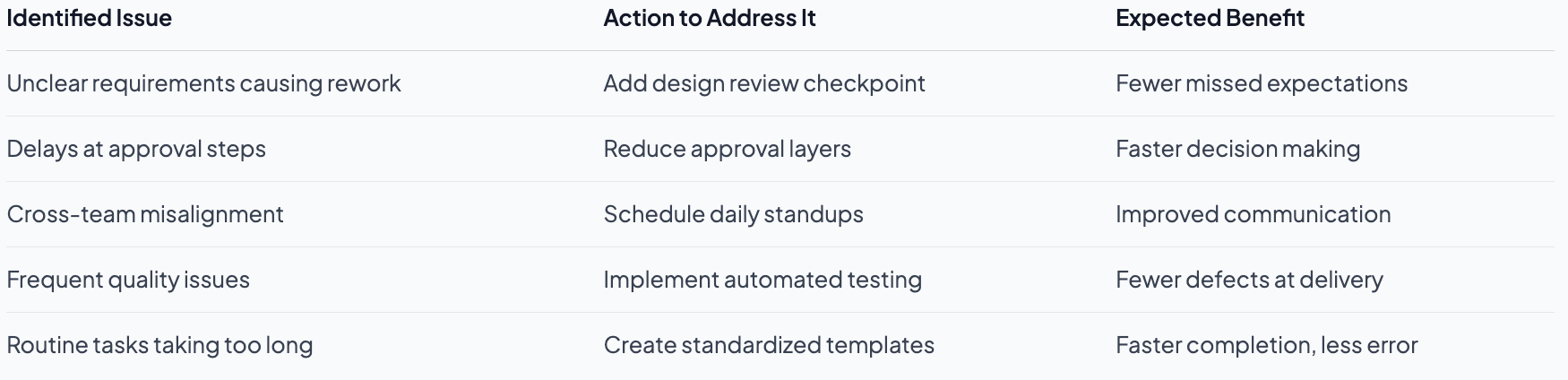
- Add a design review checkpoint before development starts
- Reduce the number of approval steps for minor changes
- Schedule daily standups for cross-functional dependencies
- Implement automated testing to catch quality issues faster
- Create templates for recurring task types
Iterative evaluation combining formative and summative approaches helps you validate outcomes while identifying improvements simultaneously. Don’t wait until the project is dead to learn from it.
Create an action plan for your next project. Which three improvements will you implement? Who owns each one? When will you implement them? Without accountability and timeline, improvements stay as suggestions.
The difference between a one-time success and a repeatable process is capturing what you learned and actually applying it next time.
Pro tip: Schedule your retrospective or project closeout within one week of completion while details are fresh, and limit the meeting to 90 minutes—longer sessions lose focus and participation.
Master Your Project Management Workflow for Tech Delivery Excellence
Defining clear scope, configuring effective workflows, managing tasks, and validating outcomes are critical yet challenging steps detailed in this guide. If you find yourself struggling with scope creep, unclear roles, or stalled progress these pain points can weigh heavily on your project’s success. Our tailored education consulting services focus on project management and delivery execution with an emphasis on technology projects designed to help you conquer these exact challenges.
Unlock the full potential of your team with proven methods for aligning stakeholders, optimizing workflows, and monitoring progress. Explore how our expert guidance at Fifty1 Consulting can equip you to avoid costly delays and miscommunication.

Take control of your next technology project today by visiting Fifty1 Consulting and discover education paths including industry certifications like PMP and CSM that will empower you to deliver excellence consistently. Don’t let project complexities hold you back when expert support is just a click away. Start mastering your workflow now and transform your delivery success.
Frequently Asked Questions
What is the first step to define project scope in tech delivery?
Defining project scope involves documenting what you are building and what you’re not. Start by engaging your stakeholders to gather their needs and expectations, ensuring everyone is aligned from the beginning.
How can I keep my team aligned during the project execution phase?
To maintain alignment, assign tasks with clear ownership and deadlines. Conduct regular updates, such as daily standups, to ensure everyone knows current project statuses and address any blockers quickly.
What tools should I consider for managing workflow in tech projects?
Choose a project management tool that fits your team’s existing workflow rather than forcing your team to adapt to the tool. Assess what stages your work passes through and select a tool that facilitates those specific processes.
How can I effectively monitor project progress and catch issues early?
Regularly compare your planned progress against actual outcomes, reviewing task completion and roadblocks weekly. This helps identify discrepancies early, allowing you to adjust plans to mitigate future problems.
What steps should I take to validate project outcomes after completion?
Begin by comparing delivered outcomes against your original scope and success criteria. Gather your team’s insights on bottlenecks and discrepancies, then document findings to inform improvements for future projects.
How can I implement workflow improvements based on project reviews?
Identify specific issues that arose during the project and develop concrete actions to address them, such as reducing approval layers or enhancing cross-team communication. Create an action plan for your next project, assigning ownership for each improvement.
Recommended:
- What Is Project Management: Impact on IT Delivery
- What Is a Project Portfolio and Why It Matters
- 3 Practical Strategies That Actually Improve Project Delivery
- 5 Early Warning Signs Your Project Is Headed for Trouble
- Interviewing for Mid and Senior Roles: Succeed with Confidence | Pavone Academy
- How to Get a Job: A Step-by-Step Guide for Tech Pros | Pavone Academy


