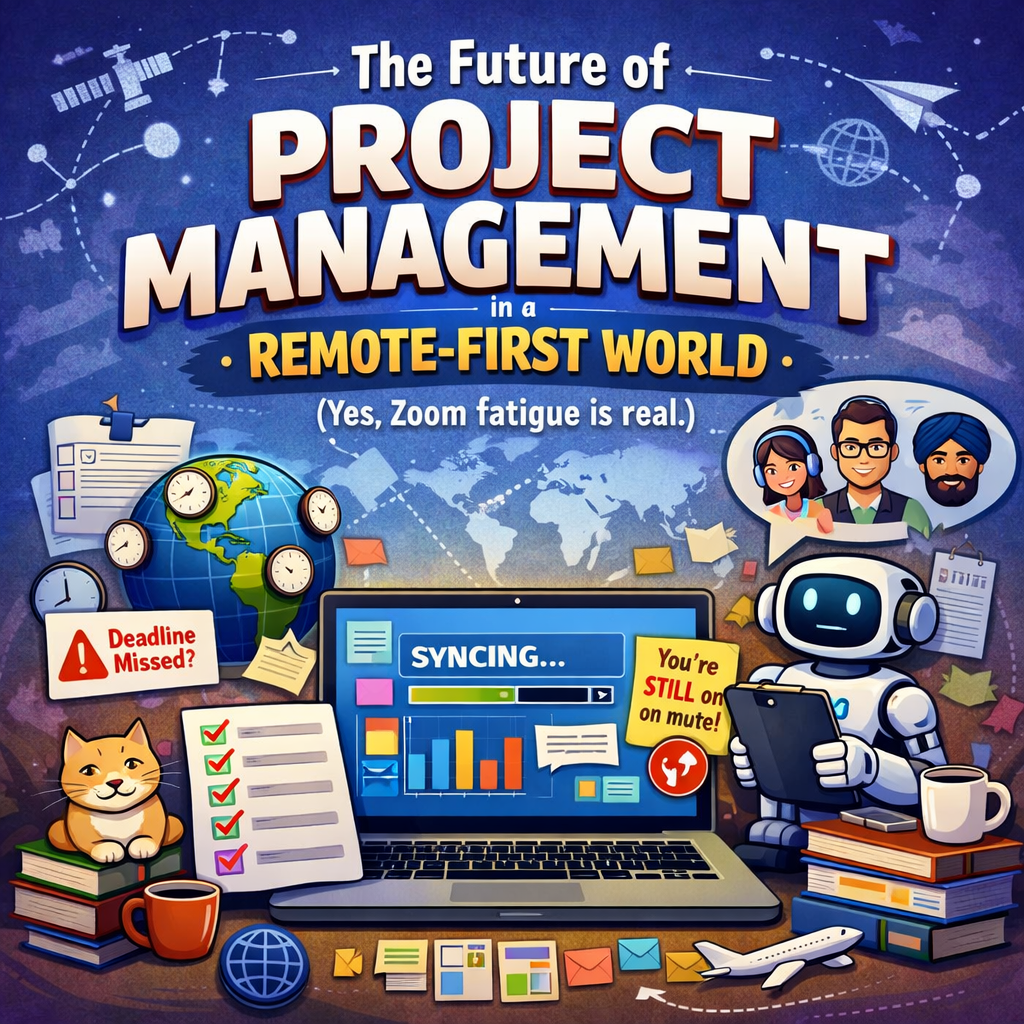
The Future of Project Management in a Remote-First World
1. Remote Work Isn’t a Phase — It’s the New Baseline
Project management has always been about communication, coordination, and herding cats.
Now we’re doing it across time zones, with half the team on mute, one person sharing the wrong screen, and someone else forgetting they're still on last week's meeting link.
Remote isn’t a trend. It’s the operating system now.
This post explores how project management is evolving in a world where the office is optional — but delivery definitely isn’t.
2. What Hasn’t Changed — And What Definitely Has
Still true:
- Scope creep exists.
- Risks don’t self-identify.
- Timelines are optimistic lies unless managed properly.
What’s changed:
- The way we communicate (spoiler: it’s 90% Slack and passive-aggressive comments in Google Docs).
- How we collaborate (turns out, everyone doesn’t read the project plan).
- What “being aligned” means (and no, it’s not everyone showing up to a standup at the same time).
The PM playbook hasn’t vanished — it just got digitized and thrown into Notion, where it now quietly gathers digital dust.
3. The Core Shifts in Remote-First Project Management
🛰 Asynchronous > Real-Time
Meetings are now a luxury. Or a punishment. Depends.
The new standard? Async updates, clear documentation, and less “hop on a quick call” energy.
If you can't explain it clearly in writing, you probably don’t understand it yet. At 51, we live and breathe this. There is more than enough data being collected (or there should be) and more than enough robust tools to articulate things asynchronously. You shouldn’t have meetings to read to stakeholders. “Popcorn, I’m busy”
📊 Tools Are Your Second Brain
You're not just managing tasks — you’re managing a tech stack that looks like a startup’s cap table.
Airtable, Linear, Miro, Notion, Asana — pick your poison. But be sure not to pick all the poisons. We see this all too often where orgs will use 2,3, sometimes more tools that all can accomplish the reporting and clarity you need. Why? Either the team doesn’t know how to use 1 of the tools and/or doesn’t have it configured correctly. Sorry, you really don’t need Smartsheet, Asana, and Airtable all ported into PowerBi for dashboards.
Regardless with how simple or complex your tooling system is, your job now includes designing systems to support the project needs, not just updating them.
🧭 Visibility = Trust
No one’s bumping into stakeholders in the hallway anymore (at least not often). If it’s not documented, it doesn’t exist. If it’s not visible, it’s not happening. Dashboards, async updates, and living roadmaps are the new open-door policy.
We recently had a conversation with a client PMO director about transparency. Specifically, the tendency of some stakeholders to avoid reporting uncomfortable truths. If you have seven open issues, report the seven. Don’t spin. Don’t sugarcoat. Just say what’s real.
The moment you start gatekeeping updates to protect someone’s boss, or shield a friend, is the moment you lose trust. It’s not helpful to say: “Well, we technically have one issue, but three are basically resolved pending a meeting we haven’t scheduled yet, and the rest are low impact.”
If your house is on fire, you don’t call 911 and say, “My thermostat feels a little high,” and expect them to come put it out.
🌎 Global Teams Are the Default
You’re managing deliverables across three continents and five calendars. Even if you’re one of the unfortunate ones who have a 5 day in-office mandate. You’re likely manaig off shore teams and some remote assets.
Async handoffs, timezone overlap planning, and the sacred "24-hour response window" are now just table stakes.
Sleep is the new bottleneck. Better have things documented and well visible for all who need to see.
4. New Skills PMs Need to Thrive in a Remote-First World
- Written communication > verbal charisma
No one cares how charming you are on Zoom if your Jira tickets are chaos. If a new team member can’t open your ticket and understand what is going on, it needs work. - Digital facilitation skills
Can you run a workshop, retro, or planning session without a whiteboard, coffee (Meaning providing coffee for all. Don’t skip your coffee), or collective groaning? That’s your superpower now. This is not always an easy thing to do. Practice helps! - Tool fluency
Not just knowing the tools — knowing when not to introduce yet another one. Take a course on the tools you are currently using. Seek admin certifications if they’re available. You won’t accomplish any of the above in section 3 if you don’t understand the capabilties. - Clarity without supervision
Leading without lurking. Driving without micromanaging. Good PMs guide from a distance — and that’s not a metaphor anymore.
5. What High-Performing Remote Teams Are Doing Differently
- They over-communicate expectations. Because ambiguity doesn’t scale.
- They automate the boring stuff. Daily standups via bots. Status reports auto-generated. It’s 2026, let robots do the admin.
- They invest in onboarding and rituals, because culture doesn’t happen by accident.
- They document everything. Decisions, context, even the bad ideas. Especially the bad ideas.
- They replace meetings with structure — structured updates, structured async comments, structured “this could’ve been an email” moments. If you’re in back to back meetings for 8 hours a day, 5 days a week, that’s a broken system.
6. The Death of the Traditional PMO? (Not Quite)
The PMO isn’t dead. It’s just working remotely now.
Old PMOs were compliance centers with a Gantt chart addiction. (We still love a good Gantt chart of course!)
Modern ones are enablement hubs — building toolkits, templates, and scalable governance without becoming a bottleneck.
Think:
- Playbooks > Policies
- Templates > Bureaucracy
- Guidance > Control
PMOs aren’t going away. They’re just getting a long-overdue rebrand. Afterall, the PM controls the momentum of the project,.
7. Predictions: What Comes Next for Remote PM
- Product PMs > Process PMs: Business impact over perfect workflows.
- AI in the loop: Auto-generated risk alerts, predictive timelines, and real-time status summaries — so you can spend more time solving problems, not formatting slides.
- Tool consolidation: The current 17 tools with 19 status definitions? That’s unsustainable. Unification is coming.
- PMs as strategic partners: The checkbox monkeys are being replaced by outcome owners. PMs who understand the business and the backlog are the ones who stay.
8. Remote-First PM Isn’t Harder — It’s Just Different
Yes, Zoom fatigue is real. So are distributed teams, async workflows, and the constant temptation to work in pajamas.
But the fundamentals haven’t changed.
PMs still need to drive clarity, build alignment, and deliver outcomes they’re just doing it through Slack threads, shared docs, and timezone math now.
The future belongs to the PMs who can lead from anywhere and still hit the deadline.


