

Applying for the PMP exam feels like navigating a maze of requirements, deadlines, and decisions. For technology professionals aiming to step up in leadership, understanding the Project Management Institute’s rules is your first real test. This guide highlights the critical steps to assess eligibility, choose effective resources, build a practical study plan, and track progress. By mastering each phase, you strengthen your project delivery foundation and unlock new opportunities for career growth.
Quick Summary

Step 1: Assess your PMP eligibility and requirements
Before you register for the PMP exam, you need to verify you meet the Project Management Institute’s (PMI) strict eligibility criteria. This isn’t a casual checkpoint—the PMI takes it seriously, and so should you. Getting this wrong means wasted time and application rejection.
The PMI requires two main things: relevant education and project management experience. Your experience must come from leading and directing project tasks, not just supporting others. Understanding what project management actually entails helps you accurately document your experience in ways the PMI recognizes.
Here’s what you need to verify:
Experience doesn’t mean being a project coordinator or junior team member. The PMI wants proof you’ve led initiatives, made decisions, and owned outcomes. You must document specific projects showing your role, duration, and the team size you managed.
Next, grab a copy of the current PMI Handbook. Download it directly from PMI’s website and read the eligibility section word for word. Don’t rely on secondhand summaries—the rules change, and you need the official version. Create a spreadsheet listing your projects with dates, responsibilities, and hours contributed. Be honest. The PMI verifies backgrounds randomly, and misrepresenting experience gets your certification revoked permanently.
You’re also looking at education requirements beyond your degree. The PMI expects 35 hours of project management education (called contact hours). Many employers offer this through training programs, and some PMP prep courses count toward this requirement.
Here’s a summary to help you quickly assess PMP exam eligibility paths:

Document everything now before you apply. The PMI’s approval process moves fast, but corrections take weeks.
Pro tip: Start gathering project documentation and timelines now, even if you won’t apply for months. Once you begin the formal application, PMI may contact previous employers for verification, and delays hurt your timeline.
Step 2: Select the right study materials and resources
Choosing the right study materials makes or breaks your PMP exam performance. Bad resources waste months of your time while good ones accelerate your learning and boost your score significantly. You need a strategic approach, not just grabbing whatever’s popular.

Start by understanding the exam’s scope and format. The PMP tests your knowledge across five domains: people, process, business environment, and measurement. Understanding project management fundamentals gives you the foundation to evaluate which resources actually align with what PMI tests versus fluff that sounds relevant but won’t help on exam day.
You’ll want multiple resource types working together:
Don’t fall for the trap of buying every single course on the market. Quality beats quantity every time. A solid PMP prep course combined with official PMI resources and consistent practice exams beats five mediocre courses any day.
Read reviews from people who actually passed the exam recently. Check Reddit communities, PMI forums, and professional networks. Ask colleagues what helped them succeed. Real feedback from successful test-takers beats marketing claims.
Budget around 4 to 6 months for study if you’re working full-time. That timeline gives you breathing room to absorb complex material without burning out. Your study materials should support this pace, not rush you.
The
combines strategy with practice, giving you both the knowledge and the tactics to perform under pressure.
Pro tip: Start with one primary course and the PMBOK Guide, then add practice exams after 6 weeks of study. Adding too many resources at once overwhelms you and dilutes your focus—master the fundamentals first, then deepen with additional materials.
Use this table to compare popular PMP study resources and how each benefits your exam prep:

Step 3: Develop a focused PMP exam study plan
A study plan transforms vague intentions into concrete progress. Without one, you drift between topics, repeat material unnecessarily, and lose momentum. A solid plan keeps you accountable and shows exactly where you stand three weeks before exam day.

Start by mapping out your timeline realistically. If your exam is four months away and you work full-time, commit to 10 to 12 hours per week. That’s roughly two hours daily or larger blocks on weekends. Block this time on your calendar like it’s a client meeting—non-negotiable.
Divide your study into phases that match the exam’s five domains:
Assign each domain specific resources based on your learning style. Visual learners might spend more time on videos while readers prefer the PMBOK. Your project management templates help you practice real scenarios, not just memorize definitions.
Set weekly milestones. “Study more” doesn’t work. Instead, write “Complete PMBOK Chapter 4 and pass domain practice quiz by Friday.” Measurable goals keep you honest and motivated.
Incorporate practice exams starting week four. Take them under timed conditions, review wrong answers immediately, and note patterns in your mistakes. This reveals what actually needs more study versus material you’ve already mastered.
Adjust your plan as you go. If a topic consistently trips you up, spend extra time there. If you’re crushing certain sections, move forward. Plans are flexible guides, not rigid contracts.
Your study plan succeeds when it’s specific enough to guide daily actions but flexible enough to adapt as you learn.
Pro tip: Schedule practice exams for the same time of day as your actual exam appointment. Your brain and energy levels matter—training your endurance at 8 AM helps if the real test is at 8 AM.
Step 4: Practice with realistic PMP mock exams
Mock exams are your training ground. They reveal knowledge gaps, build exam stamina, and desensitize you to test pressure. Without them, you’re guessing on exam day. With them, you’re executing strategy.
Start taking full-length practice exams around week four of your study plan. A realistic mock exam mirrors the actual PMP test: 180 questions, four hours, multiple-choice format, and similar difficulty distribution. Anything less is just practice, not preparation.
Here’s how to get maximum value from each mock exam:
Take at least four full-length mocks before exam day. Your first mock typically shows your starting point. By mock four, you should see consistent improvement in overall score and faster completion times. If you’re not improving, your study approach needs adjustment.
Analyze patterns in your mistakes. Are you consistently wrong on risk management? Schedule extra study there. Missing questions about communication? That’s your focus next week. The PMP Exam Playbook teaches strategic approaches to these common trouble areas.
Don’t obsess over individual exam scores. What matters is trajectory and understanding concepts, not hitting a magic number. Someone scoring 72 percent on a hard mock with deep knowledge of wrong answers beats someone scoring 78 percent who doesn’t understand their errors.
Your final mock should happen three to five days before the real exam. This keeps your momentum while giving you recovery time. You want to arrive at test day confident, not exhausted.
The quality of your mock exam preparation directly predicts your actual exam performance. Take this seriously.
Pro tip: After each mock, spend 30 minutes writing explanations for every question you missed—not just reading the answer. Writing forces your brain to process deeply, converting surface knowledge into actual understanding.
Step 5: Review progress and refine your preparation
Reviewing your progress isn’t optional—it’s how you catch failing strategies before exam day. Midway through your study plan, you need to pause and assess honestly. Are you improving? Are your weaknesses shrinking? Is your approach actually working?
Pull your mock exam data and look at the numbers. Compare your first and second exams, then your second and third. You should see improvement of 5 to 10 percent between mocks. If scores are flat or declining, something is broken and needs fixing immediately.
Analyze performance by domain and question type:
Look at your study habits too. Are you actually studying when scheduled, or constantly pushing sessions back? Are you distracted by your phone? Are you reviewing material or just passively reading? Honest self-assessment here matters more than your score.
If a particular study resource isn’t clicking, replace it. Your project leadership approach matters—some people learn through videos, others through reading and writing. Work with your brain, not against it.
Adjust your study plan based on findings. If you’ve mastered three domains but one is still shaky, reallocate study hours. Cut time from strong areas and double down on weakness. Flexibility beats rigidity.
With two weeks until exam day, your focus narrows. Stop learning new material. Instead, review weak domains, retake challenging questions, and build confidence in areas you know well. This is refinement mode, not exploration mode.
Progress without adjustment is just persistence. Adjustment without data is guessing. Combine both.
Pro tip: Create a “mistakes journal” listing every wrong answer with your incorrect thinking and the correct concept. Review this journal daily during your final week—these are your exact vulnerabilities.
Accelerate Your PMP Exam Success with Expert Guidance
Preparing for the PMP exam requires precise planning, solid resources, and targeted practice. If you feel overwhelmed by strict eligibility criteria, managing study plans, or identifying the right practice materials the stress can be draining. You are not alone in aiming to lead projects confidently by mastering concepts like leadership requirements, domain-focused study, and realistic mock exams.
Take control of your PMP preparation journey with tailored support from Fifty1 Consulting. Our education consulting specializes in project management and delivery execution, combining proven strategies with expert insight to boost your confidence and exam readiness.
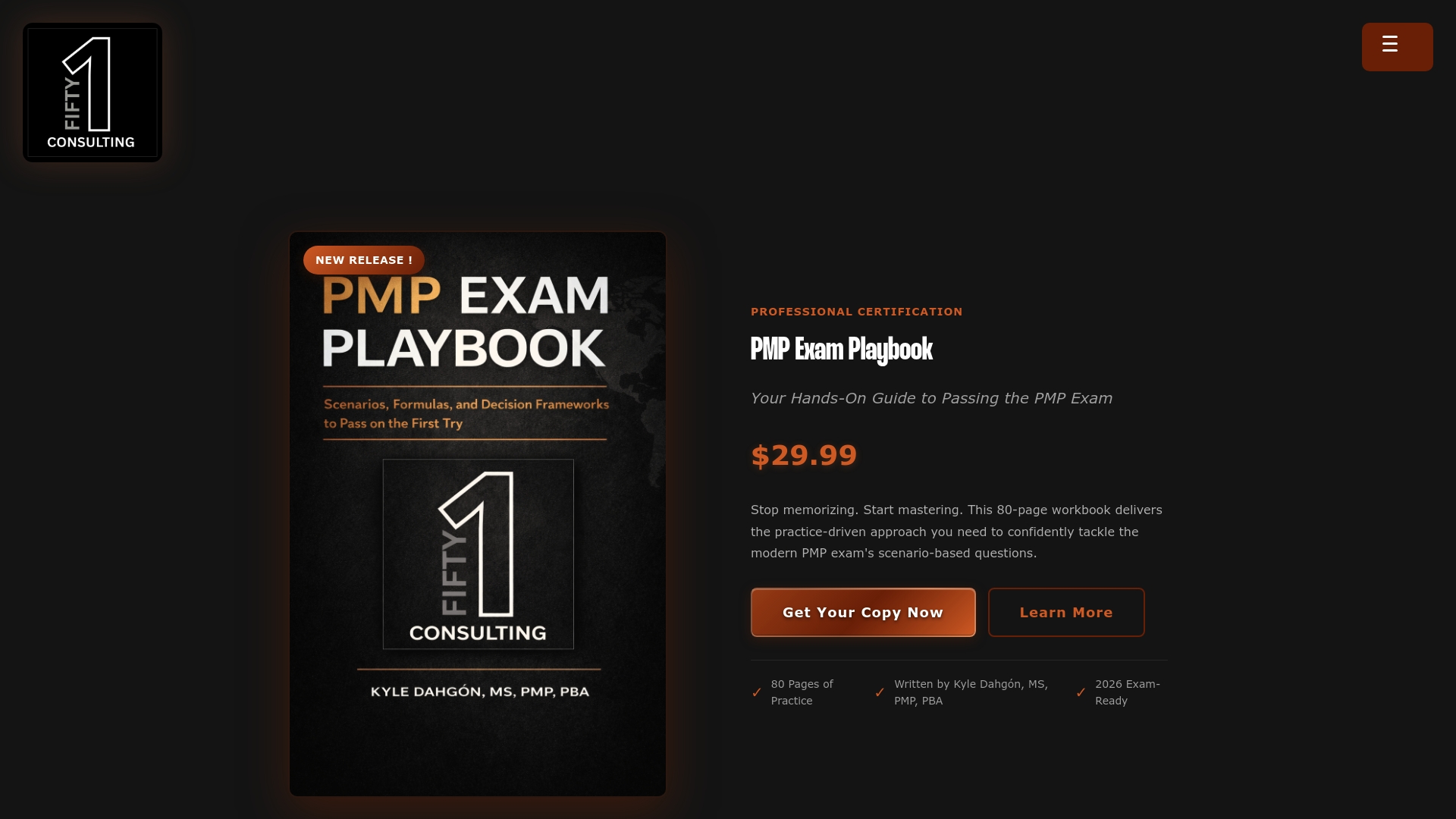
Empower yourself now by leveraging tools like the PMP Exam Playbook and study plans that adapt to your unique goals. Don’t wait until it’s too late to identify weak spots or waste time with ineffective resources. Visit Fifty1 Consulting and explore how our tailored guidance can turn your PMP exam challenges into project success stories.
Frequently Asked Questions
How do I assess my eligibility for the PMP exam?
To assess your eligibility for the PMP exam, verify your education level and project management experience. Ensure you have the required project management experience leading and directing tasks, typically documented in a spreadsheet format.
What study materials should I use for the PMP exam preparation?
Use a combination of official PMI resources, high-quality PMP exam prep courses, and practice exam simulators. Incorporate video courses and study groups for a well-rounded understanding of the topics.
How can I create an effective study plan for the PMP exam?
Develop a study plan by mapping out your timeline and dividing study sessions by the exam’s five domains. Set measurable weekly milestones and assign specific resources to each domain based on your learning preferences.
When should I start taking mock exams for the PMP exam?
Start taking full-length mock exams around week four of your study plan to gauge your readiness. Aim for at least four full-length mocks before the real exam, analyzing patterns in your performance to adjust your study focus accordingly.
What should I do if I’m not improving in my practice exams?
If you’re not improving in your practice exams, analyze your performance by domain and question type. Identify gaps in your knowledge and adjust your study hours to target weaker areas while also assessing your study habits.
Recommended:


