

Tech projects fail at an alarming rate, with over 60% missing deadlines or budgets due to scope creep, poor communication, and lack of proper methodology. Success requires a structured approach combining proven frameworks, professional certifications, and risk management. This guide walks you through the prerequisites, execution steps, common pitfalls, and measurable outcomes that separate successful tech projects from costly failures.
Key takeaways

Prerequisites for managing tech projects
You can’t build a successful tech project on a shaky foundation. Before writing a single line of code or scheduling your first sprint, ensure these critical prerequisites are in place.
Stakeholder alignment is your first checkpoint. Every key decision maker must agree on project goals, success criteria, and resource allocation. Misalignment here creates conflicts that derail projects months later. Document these agreements in writing so everyone stays accountable.
Clear project scope documentation prevents the scope creep that causes 37% of tech project failures. Define deliverables, boundaries, and exclusions explicitly. What’s not in scope matters as much as what is. Your scope document becomes your shield against endless feature requests and shifting priorities.
Read more: 37% of tech project failures
Team validation comes next. You need people with the right technical skills, but also the soft skills to collaborate effectively. Run a skills assessment and identify gaps early. A validated team executes faster and encounters fewer surprises.

Project complexity assessment guides your methodology choice. Simple projects with fixed requirements suit Waterfall. Complex projects with evolving needs demand Agile or hybrid approaches. Misjudging complexity leads to methodology mismatches that waste time and money.
Key prerequisites checklist:
Pro Tip: Schedule a prerequisites review meeting one week before official project kickoff. This buffer catches missed items before they become expensive problems.
Core steps for managing tech projects
With your foundation set, follow this structured execution process that combines proven methodologies with certification-backed practices.
Start by establishing your project governance structure. Define decision-making authority, escalation paths, and communication protocols. Who approves scope changes? How do teams report progress? Answering these questions upfront prevents confusion later.
Choose your project management framework based on your complexity assessment. PMP-aligned Waterfall works for projects with fixed requirements and regulatory constraints. Agile frameworks excel when requirements evolve. Hybrid approaches blend both for maximum flexibility.
Implementing Agile Scrum with Certified Scrum Masters reduces delivery time by 25-30% compared to traditional methods. CSM-certified practitioners bring standardized practices that improve team coordination and reduce rework. They facilitate effective sprint planning, daily standups, and retrospectives that keep projects on track.
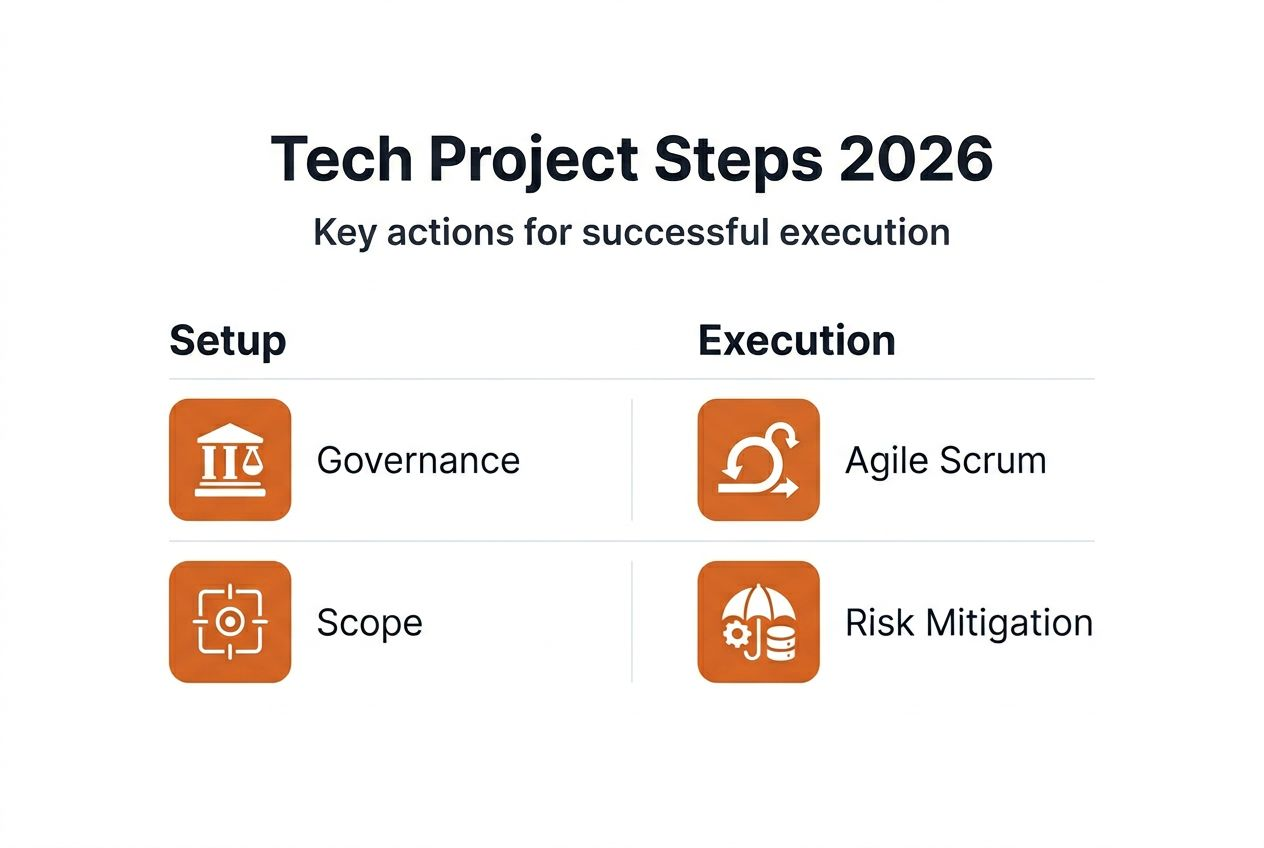
Risk management integration happens parallel to execution. Identify risks early, assess their impact, and create mitigation plans. Review your risk register weekly. New risks emerge constantly in tech projects, so static risk management fails.
Communication channels require deliberate design. Establish regular touchpoints like daily standups for teams, weekly stakeholder updates, and monthly steering committee reviews. Use agile communication principles to keep information flowing without creating meeting overload.
Structured execution steps:
Progress monitoring with success metrics closes the execution loop. Track velocity, burn rate, defect density, and stakeholder satisfaction. These numbers tell you if you’re on track or need course corrections.

Pro Tip: Create a project dashboard that updates automatically from your tracking tools. Manual reporting wastes time and introduces errors. Automated dashboards give stakeholders real-time visibility without extra work.
Integration of certifications and methodologies
Professional certifications aren’t just resume padding. They provide standardized frameworks that measurably improve project outcomes when applied correctly.
PMP certification delivers a 28% higher project success rate according to PMI research. PMP-certified managers understand the full project lifecycle, from initiating through closing. They apply proven techniques for scope management, schedule control, and stakeholder engagement. This systematic approach catches problems early and keeps projects aligned with business goals.
Certified Scrum Masters transform Agile execution. CSM certification teaches facilitation skills, Scrum ceremonies, and team dynamics that pure theory misses. CSM-led teams deliver faster because they avoid common Agile pitfalls like unclear sprint goals or ineffective retrospectives.
PBA certification improves requirement accuracy, reducing costly rework. Business Analysts certified through PMI bring structured elicitation techniques and stakeholder management skills. They bridge the gap between business needs and technical implementation, ensuring teams build the right solution.
Combining certifications with practical experience creates multiplicative benefits. A PMP with ten years of tech delivery experience applies certification frameworks with nuanced judgment. They know when to follow the playbook strictly and when to adapt.
Certification signals professional credibility to stakeholders and team members. It demonstrates commitment to industry standards and continuous learning. Clients and executives trust certified project managers more readily, smoothing approvals and resource allocation.
Key certification benefits:
Pro Tip: Pursue certifications that match your project types. If you manage software projects with evolving requirements, prioritize CSM over PMP. For large, regulated projects, PMP provides more value. Check out this article to understand which credential fits your career path.
Common mistakes and failure points in tech project management
Even experienced project managers fall into predictable traps. Recognizing these failure patterns helps you avoid them.
Scope creep remains the top killer, causing 37% of project failures. It starts innocently with small additions that seem reasonable. Each minor change adds up until your project is unrecognizable from the original plan. Combat scope creep with a formal change control process that requires stakeholder approval and impact assessment for every modification.
Poor communication and unclear roles cause over 60% of failures. Team members duplicate work or leave gaps because responsibilities aren’t defined. Stakeholders feel blindsided by problems because updates were inconsistent. Fix this with a RACI matrix defining who is Responsible, Accountable, Consulted, and Informed for each deliverable. Schedule regular communication at frequencies matching stakeholder needs.
Ignoring risk management creates expensive surprises. Projects that skip risk planning face 40% higher cost overruns when problems emerge. Establish a risk register during planning and review it weekly. Assign risk owners and track mitigation actions. Early warning signs like slipping milestones or increasing defects signal trouble before it becomes catastrophic.
Read more here:
Overreliance on one methodology reduces adaptability. Pure Waterfall struggles with changing requirements. Pure Agile lacks predictability for fixed-deadline projects. Rigid adherence to any single approach limits your options when projects evolve.
Neglecting team dynamics and morale impacts delivery quality. Burned out teams produce buggy code and miss deadlines. Toxic team cultures drive away top talent mid-project. Invest in team building, recognize contributions, and address conflicts quickly.
Common failure points to avoid:
Understanding the hidden costs of poor project management motivates vigilance around these failure points. Prevention costs less than correction.
Read more here:
Hidden costs of poor project management
Alternative approaches with tradeoffs
No single methodology fits every tech project. Understanding alternatives helps you select the best approach for your specific situation.
Hybrid Agile-Waterfall combines structured planning with iterative execution. Use Waterfall phases for initial requirements and architecture, then switch to Agile sprints for development. This works well when you need regulatory compliance documentation but face evolving technical requirements. The tradeoff is complexity. Teams must understand both methodologies and know when to apply each.
Hybrid approaches require 35% longer learning curves according to project management research. Your team needs training in both frameworks and guidance on switching between them. This investment pays off on large, complex projects but adds overhead to smaller efforts.
Pure Agile prioritizes speed and flexibility over predictability. You deliver working software quickly and adapt to feedback continuously. This excels for startup products or internal tools where requirements emerge through use. The downside is less certainty around final scope and delivery dates. Stakeholders comfortable with ambiguity thrive with pure Agile. Those needing fixed commitments struggle.
Waterfall provides control and predictability through sequential phases. You complete requirements before design, design before development. This suits projects with stable requirements and regulatory constraints. The tradeoff is rigidity. Changes become expensive once you move past early phases. Late-stage requirement changes can require rework across multiple completed phases.
Lean and Kanban focus on flow optimization and waste reduction. They work well for maintenance projects and continuous delivery scenarios. The tradeoff is less emphasis on comprehensive planning. Teams must have strong self-management skills.

Your choice depends on project complexity, requirement stability, regulatory needs, and team capabilities. Explore hybrid project management methods to understand when mixing approaches makes sense.
Pro Tip: Start with the simplest methodology that meets your needs. You can always add complexity later, but simplifying an over-engineered process is harder.
Expected results and outcomes
Setting realistic expectations helps you measure success and make informed decisions throughout project execution.
Typical tech projects run six to twelve months depending on complexity and scope. Small internal tools might complete in three to six months. Enterprise systems with integrations often take twelve to eighteen months. These timelines assume proper planning, adequate resources, and reasonable scope.
Certified project managers achieve 28% higher success rates compared to uncertified peers. This improvement comes from applying proven frameworks, avoiding common mistakes, and communicating effectively with stakeholders. The certification knowledge translates to fewer surprises and better risk management.
Risk management can cut failure rates by up to 30% when implemented proactively. Projects that identify and mitigate risks weekly catch problems before they derail timelines. This involves regular risk register reviews, scenario planning, and maintaining contingency budgets.
CSM certification leads to 25-30% faster delivery times through improved team dynamics and ceremony facilitation. Scrum Masters remove impediments, facilitate effective meetings, and coach teams on Agile principles. This reduces wasted effort and keeps development flowing.
Regular progress monitoring enables timely adjustments. Weekly reviews of velocity, budget variance, and quality metrics show trends before they become problems. You can reallocate resources, adjust scope, or escalate issues while corrective action still works.
Realistic outcome benchmarks:
Track these project success metrics throughout execution. Comparing your project to these benchmarks reveals if you’re on track or need intervention. Understanding certification impact on results helps you decide which credentials to pursue.
Discover professional project management support and certifications
Managing complex tech projects becomes easier with expert guidance and proven certifications. Fifty1 Consulting specializes in helping technology project managers succeed through tailored education and consulting services.

Explore professional project management certifications like PMP, CSM, and PBA that measurably improve project outcomes. These credentials provide frameworks you can apply immediately to increase success rates and reduce delivery times.
Partner with consultants who understand technology delivery challenges. Fifty1 Consulting offers practical support that goes beyond theory, helping you implement methodologies that fit your specific project needs. Get guidance on certification selection, methodology adoption, and overcoming common project obstacles.
Frequently asked questions
What benefits do certifications provide beyond methodology knowledge?
Certifications offer standardized frameworks, professional credibility, and structured problem-solving approaches that reduce project risks. They signal commitment to industry best practices and provide common language for cross-functional teams. Certified managers access peer networks and continuing education that keeps skills current.
How should I handle changing requirements mid-project?
Implement a formal change control process requiring impact analysis and stakeholder approval. Assess how each change affects scope, timeline, budget, and quality. Prioritize changes using business value scoring and defer non-critical items to future phases. Agile frameworks handle changes more easily than Waterfall through iterative sprints.
What success metrics should I track for tech projects?
Monitor sprint velocity, budget variance, defect density, and stakeholder satisfaction as core metrics. Add technical debt ratio, code coverage, and deployment frequency for software projects. Review metrics weekly to spot trends early. Customize metrics to match your project goals and stakeholder priorities.
How can I improve team communication efficiently?
Establish regular touchpoints matching information needs without creating meeting overload. Use daily standups for teams, weekly stakeholder updates, and monthly steering reviews. Implement collaboration tools that centralize communication and reduce email clutter. Create a RACI matrix so everyone knows their role in communication flows.
When should I use hybrid methodologies instead of pure Agile or Waterfall?
Choose hybrid when projects need both structure and flexibility. Use it for regulated environments requiring documentation but facing evolving requirements. Apply hybrid for large initiatives where different workstreams suit different methodologies. Ensure your team has skills in both frameworks before committing to hybrid approaches.
Recommended:


