

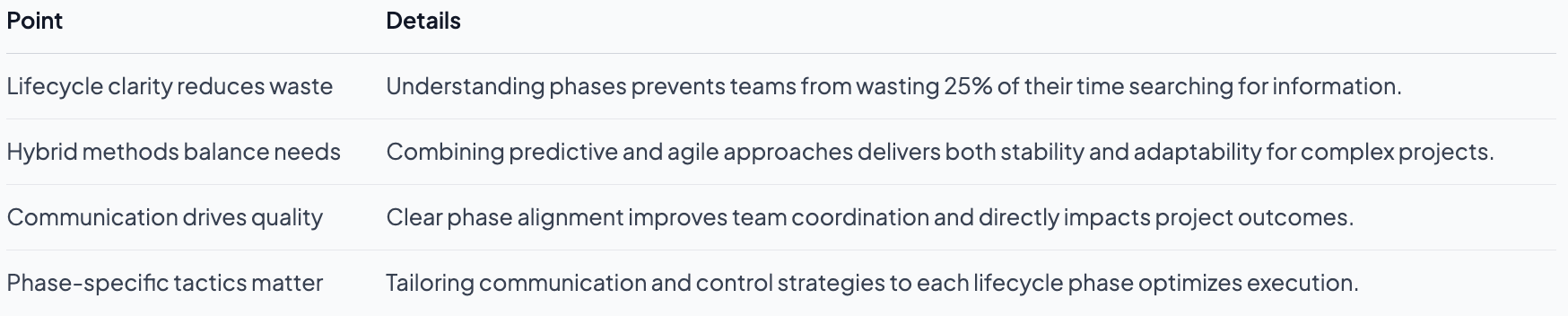
Project managers waste countless hours searching for information because lifecycle phases remain unclear. Studies reveal that 25% of teams spend a quarter of their week just hunting down project data. Misconceptions about methodologies compound these inefficiencies, leaving technology delivery professionals struggling to align execution with strategic goals. This guide clarifies the project lifecycle phases and demonstrates how to align approaches for measurable outcomes. You will discover evidence-based insights that transform project execution, reduce wasted effort, and elevate team communication.
Key takeaways
Understanding the project lifecycle: phases and purpose
The project lifecycle provides a structured framework that guides teams from initial concept through final delivery. What is project management fundamentally involves organizing work into distinct phases that create predictable patterns for execution. This structure transforms chaotic activity into coordinated effort.
Five core phases define most project lifecycles: initiation, planning, execution, monitoring and controlling, and closure. Initiation establishes project justification and high-level scope. Planning develops detailed roadmaps, resource allocations, and risk strategies. Execution transforms plans into deliverables through coordinated team action. Monitoring and controlling tracks progress against baselines and implements corrective actions. Closure formalizes acceptance, captures lessons learned, and releases resources.
Clear phase definitions directly combat the information search problem plaguing modern teams. When 25% of teams spend a quarter of their week searching for data, the root cause often traces to poorly defined phase boundaries and unclear deliverable ownership. Each phase should produce specific artifacts that become reference points for subsequent work. Initiation creates the project charter. Planning generates the project management plan. Execution produces deliverables. Monitoring creates performance reports. Closure develops final documentation.
Effective lifecycle navigation depends on communication pathways that connect phases and stakeholders. Teams must establish clear handoff protocols between phases, ensuring that deliverables from planning inform execution activities. Stakeholder engagement strategies should evolve as projects progress through phases, with broader consultation during initiation and planning narrowing to focused coordination during execution.
Read more: What is project management
Pro Tip: Document phase deliverables in a centralized repository with version control. Create a simple matrix showing which artifacts each phase produces and who owns them. This single reference eliminates most information search waste and prevents knowledge loss during team transitions.
Phase awareness aligns team efforts by creating shared mental models of project progression. When everyone understands which phase the project occupies, they can adjust their focus and priorities accordingly. Planning phase participants concentrate on thoroughness and risk identification. Execution phase team members prioritize speed and quality. This alignment reduces conflicts and improves resource utilization.
Comparing project management approaches: predictive, agile, and hybrid
Project management methodologies shape how lifecycle phases unfold and interact. Predictive approaches, commonly called Waterfall, execute phases sequentially with formal gates between stages. Agile methodologies compress lifecycle phases into iterative cycles, repeating planning-execution-review patterns throughout the project. Hybrid approaches blend these philosophies, applying predictive methods to stable components and agile techniques to uncertain elements.
Industry data shows decline in predictive, modest growth in Agile, and notable rise in hybrid approaches between 2020 and 2023. This trend reflects organizational recognition that pure methodologies rarely fit complex technology projects. Regulatory requirements demand predictive rigor for compliance documentation. Creative components benefit from agile iteration and stakeholder feedback loops. Hybrid models accommodate both needs within a single project framework.
The growing popularity of hybrid methods addresses a fundamental project reality: technology delivery rarely fits neatly into pure categories. A single project might include infrastructure procurement requiring predictive planning, application development suited to agile sprints, and change management benefiting from iterative stakeholder engagement. Why 76 percent choose hybrid project management reflects this complexity and the need for flexible frameworks.
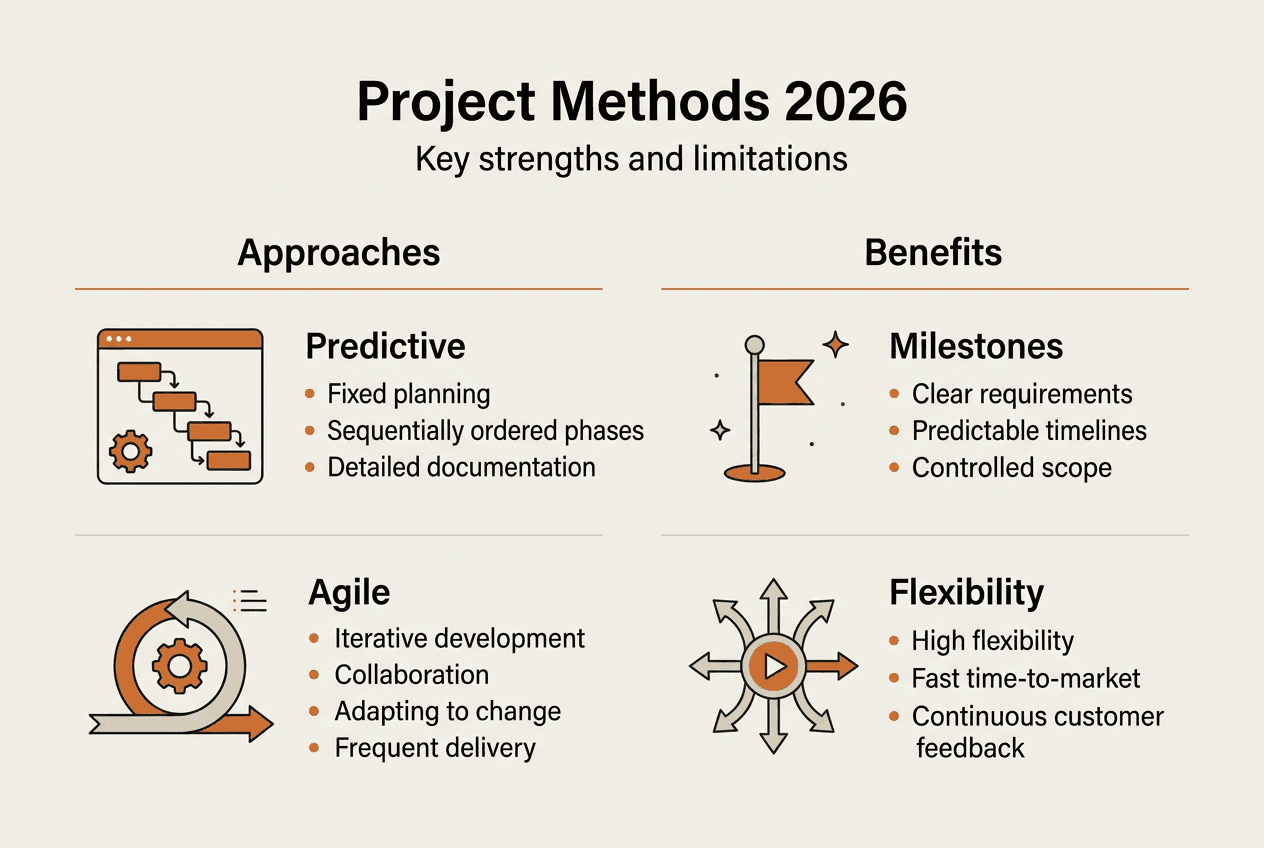
Each methodology interprets lifecycle phases differently. Predictive approaches treat phases as sequential gates with formal approvals. Agile compresses phases into sprint cycles, repeating mini-lifecycles throughout the project. Hybrid models might use predictive phases for overall structure while embedding agile iterations within execution phases. Understanding these variations helps you select appropriate tools and communication patterns.
Pro Tip: Assess project characteristics before defaulting to familiar methodologies. Create a simple scoring matrix evaluating requirement stability, regulatory constraints, stakeholder availability, and team experience. Match high scores in stability and regulation to predictive elements. Align uncertainty and innovation needs with agile approaches. This analysis produces better methodology fit than organizational habit.
Fit-for-purpose delivery recognizes that methodology choice should serve project needs rather than organizational preferences. Why agile for technology projects explains benefits for uncertain work, but forcing agile onto stable infrastructure projects creates unnecessary complexity. Similarly, applying predictive methods to innovative software development delays feedback and increases risk. Hybrid thinking allows you to match methodology to work type.
Read more: Why agile for technology projects
Enhancing project execution by aligning lifecycle with communication and quality
Communication failures directly impact project outcomes and deliverable quality. Research demonstrates that 74% of leaders believe poor communication negatively impacts work quality. This connection between communication effectiveness and project success intensifies during lifecycle transitions, where information handoffs create vulnerability points.
Lifecycle phase clarity supports better communication pathways by defining when specific conversations should occur. Initiation phases require broad stakeholder consultation to capture diverse perspectives and build buy-in. Planning phases need detailed technical discussions among specialized team members. Execution phases demand frequent coordination updates and issue resolution. Monitoring phases focus on performance data sharing and variance analysis. Closure phases emphasize lessons learned documentation and knowledge transfer.
“74% of leaders believe poor communication negatively impacts work quality, highlighting the critical connection between clear lifecycle phase understanding and project success.”
Phase-specific communication practices optimize information flow and reduce quality risks:
Integrating communication check-ins into phase gates prevents information gaps from accumulating. Before transitioning from planning to execution, verify that all team members understand their roles, deliverables, and coordination points. Before moving from execution to closure, confirm that all stakeholders acknowledge deliverable acceptance and understand ongoing support arrangements.
Project management workflow guide tech success demonstrates how systematic communication patterns embedded in lifecycle phases create predictable information flow. Teams spend less time searching for data because they know where to find phase-specific artifacts. Stakeholders receive timely updates because communication triggers tie to phase milestones rather than arbitrary calendar dates.
Read more: Project management workflow guide tech success

Practical implementation requires matching communication intensity to phase risk and complexity. High-risk execution phases might need daily coordination calls. Stable monitoring phases could rely on weekly dashboards. Tailor frequency and formality to actual project needs rather than applying uniform communication templates across all phases and projects.
Applying hybrid lifecycle models for balanced control and flexibility
Hybrid lifecycle models provide practical frameworks for managing projects with mixed characteristics. Hybrid approaches combine predictability for regulatory elements with agility for creative work, allowing teams to apply appropriate rigor where needed while maintaining flexibility elsewhere. This balance proves especially valuable in technology delivery where compliance requirements coexist with innovation imperatives.
Implementing hybrid lifecycles requires deliberate component analysis and methodology mapping:
This mapping ensures that methodology choices serve component needs rather than organizational defaults. Infrastructure procurement demands predictive rigor because vendor contracts require detailed specifications and fixed budgets. Application development benefits from agile iteration because user needs evolve as prototypes emerge. Forcing uniform methodology across these diverse elements creates unnecessary constraints or unacceptable risks.
Project management trends 2026 highlights increasing sophistication in hybrid model application as organizations move beyond simple methodology debates. The question shifts from predictive versus agile to how best to integrate both approaches within coherent project frameworks. This evolution recognizes that methodology serves project success rather than representing ideological positions.
Read more: Project management trends 2026
Pro Tip: Continuously evaluate and adapt lifecycle methods mid-project based on emerging insights and changing conditions. Schedule methodology retrospectives at major milestones to assess whether current approaches still fit evolving project characteristics. Be willing to shift components between predictive and agile treatment as uncertainty resolves or new complexities emerge.
Agile isnt just for software demonstrates hybrid thinking by showing how agile principles apply beyond traditional software contexts. Marketing campaigns, business process improvements, and organizational change initiatives all benefit from iterative approaches when uncertainty dominates. Combining these agile elements with predictive governance for budgets and compliance creates practical hybrid models.
Read more: Agile isnt just for software
Successful hybrid implementation requires team members who understand both methodologies and can translate between them. Invest in training that builds bilingual capability, allowing project managers to speak both predictive and agile languages fluently. This skill enables effective coordination across methodology boundaries and prevents communication breakdowns at integration points.
DazIQ by Fifty1
You can study the frameworks. Complete the courses. Collect the credentials.
But real growth happens when priorities change, stakeholders challenge you, timelines tighten, and decisions have to be made under pressure.
DazIQ is an AI-powered career simulation platform that helps aspiring project, product, and delivery professionals build practical confidence through realistic workplace scenarios, coaching, and feedback.
DazIQ transforms knowledge into real-world readiness.
No weekend-long video courses. No endless PowerPoints.
Just realistic scenarios, your decisions, and personalized coaching that helps you grow faster.

Frequently asked questions about the project lifecycle
What are the essential phases of a project lifecycle?
The five essential phases are initiation, planning, execution, monitoring and controlling, and closure. Initiation establishes project justification and high-level scope. Planning develops detailed roadmaps and resource allocations. Execution transforms plans into deliverables. Monitoring tracks progress and implements corrections. Closure formalizes acceptance and captures lessons learned.
How do hybrid project lifecycles improve flexibility?
Hybrid lifecycles apply predictive methods to stable components requiring formal documentation while using agile approaches for uncertain elements benefiting from iteration. This combination provides governance and control where needed without sacrificing adaptability for creative work. Teams gain both predictability for stakeholders and responsiveness to emerging insights.
What communication practices prevent project lifecycle failures?
Phase-specific communication protocols prevent failures by aligning information flow with project progression. Establish stakeholder mapping during initiation, create detailed communication matrices in planning, implement visual management during execution, distribute performance dashboards while monitoring, and facilitate structured retrospectives at closure. Integrate communication check-ins into phase gate reviews to verify information completeness before transitions.
How to decide the best lifecycle model for my project?
Evaluate project components against stability criteria including requirement clarity, regulatory constraints, technical uncertainty, and stakeholder engagement needs. Assign predictive methods to stable elements requiring formal approvals. Apply agile approaches to uncertain components benefiting from iteration. Design integration points where different methodologies synchronize. Match methodology to work characteristics rather than organizational preferences.
What signs indicate lifecycle misalignment risks?
Watch for teams spending excessive time searching for information, unclear deliverable ownership between phases, stakeholder confusion about project status, and methodology debates consuming planning time. Early warning signs your project is headed for trouble include missed handoffs between phases and communication breakdowns at transition points. Address these signals immediately by clarifying phase boundaries and establishing explicit deliverable ownership.
Recommended:


