
How PMP certification boosts tech project delivery in 2026
Technology project managers holding PMP certification earn 17% higher median salaries than their non-certified peers, yet many tech leaders still question its relevance. The common belief that PMP only applies to traditional waterfall projects misses a critical update: the 2026 exam now emphasizes agile, hybrid methodologies, and strategic business skills essential for modern technology delivery. This guide clarifies how PMP certification directly enhances execution efficiency and career prospects for technology project professionals.
Key takeaways
Introduction to PMP certification and its relevance to technology projects
PMP certification originated in 1969 and has evolved into the world’s most recognized project management credential. It validates mastery across three critical domains that directly impact technology project outcomes: People, Process, and Business Environment. These domains equip project managers with leadership capabilities, execution frameworks, and strategic alignment skills necessary for complex technology initiatives.
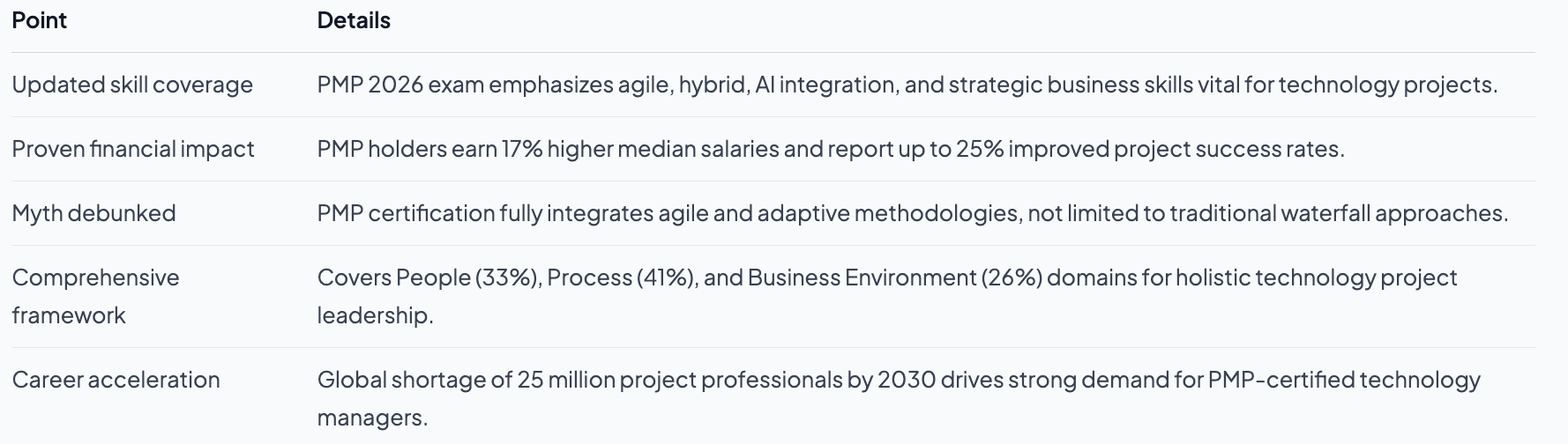
The 2026 exam update increases focus on AI, sustainability, and business environment skills, reflecting real-world technology project needs. The domain distribution shifted to People at 33%, Process at 41%, and Business Environment at 26%. This rebalancing acknowledges that successful technology delivery requires more than technical execution. It demands strategic thinking, stakeholder engagement, and adaptive leadership in rapidly changing environments.
Key changes in the 2026 PMP framework include:
- Enhanced coverage of agile and hybrid project methodologies
- Integration of AI-augmented project management practices
- Expanded focus on sustainability and ethical technology delivery
- Greater emphasis on strategic business alignment and value realization
- Practical application of risk management in fast-paced tech environments
These updates position PMP as highly applicable to technology projects where adaptive approaches and business strategy intersect. The certification framework supports both predictive and iterative project lifecycles, making it ideal for hybrid technology environments. Understanding these benefits of PMP certification for tech managers helps clarify its practical value beyond traditional project contexts.
Read more:
Benefits of PMP certification for tech managers
How PMP certification skills enhance leadership and execution in technology projects
Leadership capability distinguishes successful technology project managers from those who merely coordinate tasks. PMP certification develops skills in stakeholder engagement, team motivation, and conflict resolution that prove essential when navigating complex technology initiatives. Organizations increasingly require PMP certification for project management roles, especially in technology sectors with high-stakes, multi-phase projects.
The integration of agile and hybrid methodologies within PMP content addresses a critical need in technology delivery. Modern tech projects rarely follow pure waterfall or pure agile approaches. Instead, they blend predictive planning with iterative execution, requiring project managers who understand both paradigms. PMP certification equips professionals to select appropriate methodologies based on project characteristics, team dynamics, and organizational constraints.
Risk management skills taught through PMP preparation directly improve technology project outcomes. Technology projects face unique risks from rapidly evolving tools, security vulnerabilities, integration challenges, and shifting market demands. PMP-trained managers apply structured risk identification, assessment, and response planning that reduces project failures and cost overruns.
Core PMP skills that enhance technology project execution include:
- Adaptive planning techniques that balance structure with flexibility
- Data-driven decision making using metrics and performance indicators
- Cross-functional team leadership in matrixed technology organizations
- Scope management preventing feature creep while enabling innovation
- Resource optimization balancing capacity constraints with delivery commitments
Pro Tip: Apply PMP’s earned value management techniques to track technology project performance objectively, providing stakeholders with quantifiable progress metrics beyond subjective status reports.
The certification signals trusted capability to employers and clients handling complex technology initiatives. In competitive markets, PMP certification differentiates candidates who demonstrate commitment to professional excellence. It provides a common language for project management that facilitates collaboration across global teams and diverse stakeholder groups. Organizations with mature project portfolios particularly value PMP-certified managers who can align individual projects with strategic technology roadmaps.
Empirical evidence of PMP certification’s benefits in technology project management
Data validates the tangible benefits PMP certification delivers for technology project professionals. PMP-certified project managers report a 17% higher median salary compared to non-certified peers, indicating strong market recognition of PMP skills in technology project roles. This salary premium reflects employer willingness to invest in professionals who bring validated capabilities and reduced project risk.

Project success rates demonstrate another measurable impact. Organizations with PMP-certified project managers report up to 25% higher project completion rates within original scope, schedule, and budget parameters. This improvement translates directly to reduced waste, faster time to market, and better return on technology investments. Stakeholder satisfaction scores similarly increase when certified professionals lead technology initiatives.
The ongoing demand for certified project managers in technology fields is driven by a global shortage forecasted to be 25 million new professionals by 2030, emphasizing PMP’s strategic importance. Technology sectors experiencing rapid growth, particularly cloud computing, cybersecurity, and AI implementation, show the strongest demand for PMP-certified talent. This shortage creates exceptional career opportunities for technology professionals who invest in certification.

The certification premium reflects more than credential recognition. It represents validated mastery of skills that directly improve technology project outcomes, from initial planning through final delivery and benefits realization.
Technology organizations increasingly structure career paths requiring PMP certification for senior project roles. This requirement acknowledges that complex technology initiatives demand proven leadership and execution capabilities. Professionals who manage tech projects for success recognize certification as essential professional development. Staying current with project management trends in 2026 reinforces the ongoing value of maintaining PMP credentials in evolving technology landscapes.
Read more:
Project management trends in 2026
Manage tech projects for success
Debunking common misconceptions about PMP in technology project management
The belief that PMP applies only to traditional waterfall projects represents the most persistent misconception limiting its adoption among technology professionals. A common misconception is that PMP is only for traditional predictive projects, but the 2026 exam explicitly integrates agile and hybrid approaches making it highly relevant to modern technology projects. The updated exam content includes substantial coverage of Scrum, Kanban, lean principles, and adaptive planning techniques.
Another myth suggests PMP certification becomes outdated as technology evolves rapidly. The reality contradicts this assumption. PMI continuously updates certification content to reflect current industry practices, emerging technologies, and evolving leadership requirements. The 2026 exam revision specifically addresses AI integration, sustainability considerations, and remote team management reflecting contemporary technology project realities.
Some technology professionals believe agile-only certifications better serve their needs. While specialized agile credentials provide depth in specific methodologies, they lack the comprehensive business strategy and leadership development that PMP offers. Technology projects require more than iteration planning. They demand strategic alignment, financial management, stakeholder engagement, and organizational change management covered extensively in PMP preparation.
Common PMP misconceptions that limit technology career growth:
- PMP focuses exclusively on documentation rather than execution results
- Certification requires abandoning agile practices for rigid processes
- PMP preparation time investment exceeds practical career benefits
- Technology project speed makes structured project management irrelevant
- Agile certifications provide equivalent comprehensive project management skills
Pro Tip: Select PMP study materials explicitly updated for the 2026 exam content to ensure alignment with current agile integration, AI applications, and hybrid methodology coverage relevant to technology projects.
Understanding why agile approaches benefit technology projects complements rather than conflicts with PMP certification. The certification framework recognizes that different project characteristics require different approaches. PMP-certified professionals possess flexibility to select appropriate methodologies based on project context, team capability, and organizational maturity rather than rigidly applying single approaches regardless of fit.
Read more:
Why agile approaches benefit technology projects
Comparing PMP with other project management certifications for technology leaders
PMP certification distinguishes itself through comprehensive coverage spanning leadership, technical execution, and business strategy. While agile-specific certifications like Certified ScrumMaster or SAFe Agilist provide deep methodology expertise, they narrow focus to particular frameworks. Technology projects increasingly require hybrid approaches blending predictive and adaptive elements, making PMP’s broad scope particularly valuable.
The People domain in PMP covers leadership skills often missing from technical certifications. Conflict resolution, team development, stakeholder engagement, and servant leadership capabilities prove essential when managing diverse technology teams. These soft skills complement technical project execution knowledge, creating well-rounded project leaders.
Business Environment domain content sets PMP apart by connecting project execution to organizational strategy. Understanding benefits realization, portfolio alignment, and strategic value delivery elevates project managers beyond task coordinators to strategic contributors. Technology leaders who grasp business context make better project decisions balancing technical excellence with commercial viability.

Understanding PMO impact on technology projects highlights why comprehensive PMP skills matter. Project management offices require leaders who understand governance, standardization, and portfolio optimization alongside individual project execution. PMP preparation develops this broader perspective missing from narrowly focused certifications.
Read more:
PMO impact on technology projects
Technology professionals should select certifications matching their career trajectory and project environment. Pure agile contexts may benefit from specialized credentials. However, most technology organizations operate hybrid environments where PMP’s comprehensive framework provides greatest versatility. Combining PMP with agile expertise for technology projects creates optimal capability for modern technology leadership roles.
Practical steps for technology professionals to leverage PMP certification for career and project success
Earning PMP certification requires meeting specific prerequisites demonstrating project leadership experience. Candidates need either a four-year degree with 36 months leading projects and 35 hours of project management education, or a high school diploma with 60 months leading projects and the same education hours. Technology professionals should document their project experience carefully, highlighting leadership responsibilities rather than purely technical contributions.
Preparing effectively for the 2026 exam requires using updated study materials aligned with current content. Focus preparation on understanding concepts rather than memorizing processes. The exam tests application of project management principles to realistic scenarios, particularly emphasizing decision making in ambiguous situations. Technology professionals should practice exam questions reflecting hybrid methodology scenarios common in tech environments.
Steps to achieve and maximize PMP certification benefits:
- Audit your project experience against PMP prerequisites and document qualifying projects with leadership focus
- Complete required 35 contact hours through accredited project management education programs
- Study using 2026-aligned materials emphasizing agile integration, business strategy, and leadership domains
- Apply to PMI and schedule your exam after thorough preparation across all three domains
- Pass the PMP exam demonstrating proficiency in People, Process, and Business Environment competencies
- Immediately begin applying PMP frameworks to current technology projects for practical skill reinforcement
Maintaining PMP certification requires earning 60 professional development units every 3 years, ensuring technology project managers stay current with evolving methodologies and tools. PDUs come from continuing education, professional practice, and knowledge creation activities. This requirement encourages ongoing learning that keeps skills relevant as technology project landscapes shift.
Pro Tip: Track PDUs continuously rather than cramming before renewal deadlines by attending webinars, reading project management publications, and documenting lessons learned from technology project experiences.
Apply PMP principles to AI-augmented and hybrid technology projects by adapting frameworks to specific contexts. Use PMP risk management techniques to address AI model uncertainties. Apply stakeholder engagement approaches to navigate organizational change resistance during technology transformations. Leverage earned value management to provide objective progress reporting on complex technology initiatives. Resources like PMP exam preparation guides and project management workflow frameworks support practical application of certification knowledge.
Read more:
Project management workflow frameworks
Networking through PMI chapters and professional communities amplifies PMP benefits beyond individual credential value. Technology project managers gain access to peer learning, industry trends, and career opportunities through active professional engagement. Continuous learning combined with practical application transforms PMP from static credential to dynamic career accelerator in technology project management.
Driving technology project success with PMP certification in 2026 and beyond
PMP certification equips technology project managers with validated capabilities spanning leadership, technical execution, and strategic business alignment. This comprehensive skill set directly correlates with measurable improvements in project success rates, stakeholder satisfaction, and career advancement. The 2026 exam updates ensure content remains aligned with contemporary technology delivery challenges including AI integration, hybrid methodologies, and strategic value realization.

The certification’s value extends beyond individual career benefits to organizational impact. Technology companies with PMP-certified project managers demonstrate higher project completion rates, better resource utilization, and improved return on technology investments. These organizations benefit from standardized approaches, reduced project risk, and enhanced capability to execute complex technology initiatives successfully.
Continuous adaptation of PMP content by PMI ensures ongoing relevance despite rapid technology evolution. As new tools, methodologies, and challenges emerge in technology delivery, certification requirements evolve to maintain currency. This adaptive approach protects the credential’s value while ensuring certified professionals possess skills matching current industry demands.
Investing in PMP certification prepares technology leaders for future project challenges in increasingly complex environments. The global shortage of qualified project professionals creates exceptional opportunities for certified technology managers. Organizations competing for digital transformation success prioritize hiring and promoting professionals who bring validated project management excellence alongside technical expertise.
PMP certification serves as a catalyst for career advancement and organizational alignment in technology sectors. It provides common language facilitating collaboration across global teams, diverse stakeholders, and varied technology domains. Professionals who combine technical knowledge with PMP-validated project management capabilities position themselves as indispensable leaders capable of driving successful technology delivery in 2026 and beyond.
Explore PMP certification support at Fifty1 Consulting
Navigating PMP certification while managing demanding technology projects requires strategic guidance and efficient preparation resources. Fifty1 Consulting specializes in supporting technology professionals pursuing project management certifications with training programs explicitly aligned to 2026 exam updates. Our consulting services help technology leaders apply PMP principles directly to their current projects, accelerating both certification success and immediate project performance improvements.

We understand the unique challenges technology project managers face balancing certification preparation with ongoing delivery responsibilities. Our tailored approach focuses on practical application rather than rote memorization, ensuring you develop capabilities that enhance your technology projects immediately. Whether you’re beginning your PMP journey or seeking advanced consulting to optimize technology delivery execution, our team provides expertise spanning certification preparation, agile integration, and strategic project leadership.
Explore our comprehensive project management certifications and licenses to identify learning paths matching your technology career goals. Our resources support not only PMP preparation but also complementary certifications in agile, business analysis, and specialized technology delivery frameworks. Investing in your project management capabilities through structured learning and expert guidance accelerates both certification success and long-term career growth in technology leadership roles.
Frequently asked questions
What is the PMP certification and why is it important for technology projects?
PMP certification validates comprehensive project management skills across leadership, technical execution, and business strategy domains essential for technology delivery. It demonstrates proven capability to manage complex projects using predictive, agile, and hybrid approaches. Technology organizations increasingly require PMP for senior project roles because certified managers deliver higher success rates and better stakeholder outcomes.
How does the 2026 PMP exam update affect technology project managers?
The 2026 exam increases focus on AI integration, sustainability practices, agile methodologies, and strategic business alignment directly relevant to modern technology projects. Domain distribution shifted to emphasize Business Environment at 26%, reflecting the importance of strategic thinking in technology delivery. These updates ensure PMP remains current with fast-evolving technology project management practices and emerging industry trends.
What common myths about PMP certification should technology project leaders be aware of?
The biggest myth claims PMP applies only to traditional waterfall projects, but the 2026 exam extensively covers agile, Scrum, Kanban, and hybrid methodologies. Another misconception suggests PMP becomes outdated quickly, yet PMI continuously updates content to reflect current practices including AI-augmented project management. PMP provides comprehensive skills for adaptive, complex technology environments contrary to popular belief that it enforces rigid processes.
How can technology professionals maintain their PMP certification after earning it?
Maintaining PMP requires earning 60 professional development units every three years through continuing education, professional practice, and knowledge contribution activities. Technology project managers can earn PDUs by attending webinars, completing online courses, reading project management publications, or documenting lessons learned from projects. This ongoing learning requirement ensures certified professionals stay current with evolving methodologies, tools, and best practices in technology project delivery.
Recommended:
- 7 Key Benefits of PMP Certification for Tech Managers
- Project Management Trends 2026: Power Skills and AI Impact
- What Is Project Management: Impact on IT Delivery
- What Is a Project Portfolio and Why It Matters


