

TLDR:
Choosing the right agile approach for your technology team can feel like picking a framework off a shelf that’s stacked floor to ceiling. SAFe, Scrum, Kanban, LeSS — they all promise faster delivery and happier stakeholders. But without seeing how these methods play out in real projects, you’re essentially guessing. The good news? You don’t have to. Real-world agile project examples cut through the theory and show you what actually works, what breaks down, and what you can steal for your own team. This guide walks through proven cases, practical comparisons, and honest takeaways so you can move forward with confidence.
Key Takeaways
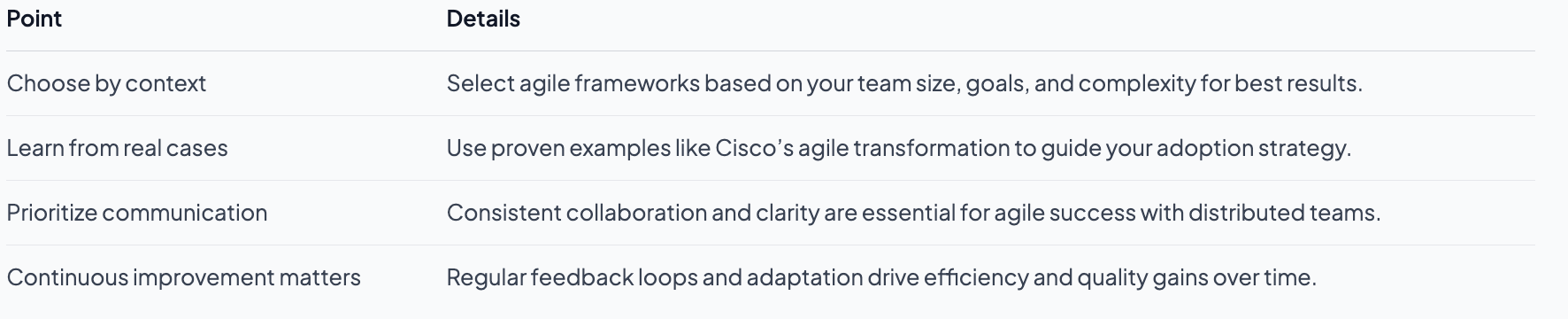
How to evaluate agile project examples for your team
Not every agile success story applies to your situation. A fintech startup running 10-person sprints has almost nothing in common with a 300-person enterprise rolling out a billing platform across three continents. Context is everything, and skipping this step is one of the most common mistakes teams make when borrowing from case studies.
Before you benchmark your team against someone else’s agile journey, ask yourself these questions:
The factors that matter most when evaluating agile examples are delivery speed, quality outcomes, team communication structures, and how well the framework adapts to change. Agile transformations work best when teams consider delivery goals, team structure, and project complexity before picking a model to follow.
One trap to avoid: copying a framework wholesale because a well-known company used it. What worked for Cisco’s 200-person billing team won’t automatically work for your 15-person product squad. Instead, map the specific practices, not the entire framework, to your actual needs.
If you’re still exploring why agile for technology projects makes sense in the first place, that’s a smart starting point before diving into case studies. And if you want to stay ahead of the curve, project management trends in 2026 show a clear shift toward hybrid and scaled agile adoption across tech firms.
Pro Tip: Always tie your agile framework choice back to a specific business goal. “We want to reduce time-to-market by 20%” is a goal. “We want to be more agile” is not.
Cisco SBP: Scaled Agile Framework transforms subscription billing
Cisco’s Subscription Billing Platform (SBP) is one of the most referenced enterprise agile transformations for good reason. The SBP team was running on waterfall, and it was costing them. Long release cycles, mounting defects, and poor cross-team visibility were slowing down a platform that millions of customers depended on.
Cisco made the call to adopt SAFe (Scaled Agile Framework), a structured approach designed for large organizations that need agile at scale without losing alignment. Here’s what that looked like in practice:
The results were measurable and significant. After adopting SAFe, Cisco’s SBP saw a 40% decrease in critical defects and a 14% increase in defect removal efficiency.


For distributed and international teams, the SBP case proves that structured agile ceremonies aren’t just bureaucracy. They’re the connective tissue that keeps large teams from drifting. If your team is spread across time zones, the resource savings from disciplined project management become even more pronounced.
One underrated lesson here: SAFe’s PI Planning events forced conversations about dependencies that were previously invisible. Teams that had been working in silos suddenly had to show their work. That transparency alone reduced rework significantly. Pair that with strong agile communication plans and you’ve got a framework that scales without falling apart.
Webex scrum: Agile delivery for global collaboration
While Cisco’s SBP story is about scaling up, the Webex case is about moving fast at the product team level. Webex needed to ship a high-quality collaboration tool to a global market, and waterfall wasn’t going to cut it. The team chose Scrum, and the results speak for themselves.
Scrum was the right call here because the Webex team had a defined product vision, a manageable team size, and a need for rapid iteration based on user feedback. Here’s how they ran it:
Webex’s adoption of Scrum led to a 25% drop in QA defects and drove the sale of 35 million tablets. That’s not a coincidence. Better quality directly translated to market success.
For distributed teams, Scrum’s daily rituals created a rhythm that replaced the informal hallway conversations you lose when your team is remote. The stand-up became the glue. If you want to see how agile project communication drives outcomes like these, the Webex model is a textbook example.
Pro Tip: Don’t underestimate the sprint retrospective. It’s the most skipped ceremony and the most valuable one. Teams that skip retros are basically choosing to repeat their mistakes.
The Webex case also reinforces something worth noting: agile isn’t just for software engineers. Product managers, QA leads, UX designers, and even marketing teams contributed to sprint cycles. If you’re curious about how agile works for business teams beyond engineering, this example is a strong starting point.
Comparison: Which agile approach fits your situation?
Now that you’ve seen both frameworks in action, let’s put them side by side. Both SAFe and Scrum delivered measurable improvements for Cisco but suited different project types and team sizes. The key is knowing which one maps to your reality.
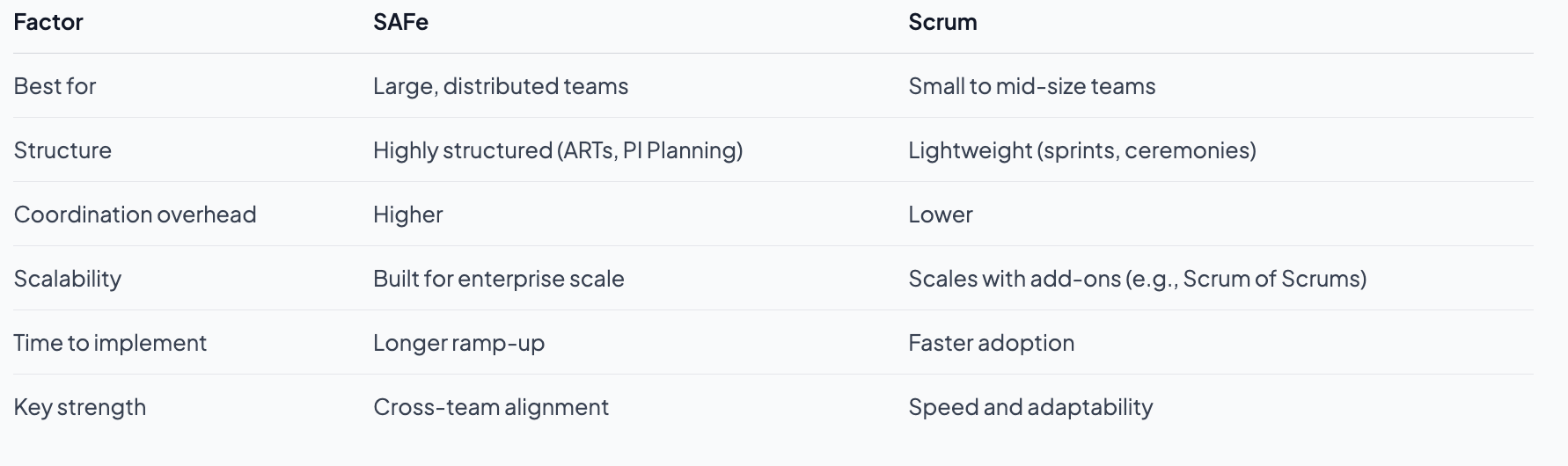
Before you decide, work through these questions:
If you’re still on the fence, it’s worth exploring hybrid project management approaches, which combine the best of agile and traditional methods. Sometimes the right answer isn’t a pure framework at all.
What most agile case studies don’t tell you
Here’s the uncomfortable truth: most agile success stories are written after the win. They skip the messy middle, and that’s exactly where most teams struggle.
Cisco’s transformations look clean in retrospect. But the reality included cultural resistance, team members who didn’t trust the new process, and managers who kept reverting to waterfall habits under pressure. No case study puts that in the headline.
The hidden cost of a poor agile rollout isn’t just wasted sprints. It’s eroded trust. When teams go through the motions of stand-ups and retrospectives without genuine commitment, the ceremonies become theater. You get the appearance of agility without the outcomes.
What actually separates successful agile teams from struggling ones isn’t the framework. It’s clarity, feedback loops, and ruthless prioritization. Teams that manage project scope with discipline and communicate blockers early are the ones that deliver. The framework is just the scaffolding.
So when you read a case study, ask what they cut, who pushed back, and what almost derailed the whole thing. That’s where the real lessons live.
DazIQ | Career Simulations
Agile project managers don't struggle with frameworks — they struggle with the moments frameworks don't cover. The stakeholder who won't commit. The sprint that's already off the rails. The room where every answer matters.
DazIQ was built for exactly that. An AI-powered career simulation platform from Fifty1 Consulting, DazIQ puts you inside those moments and coaches you through them using Socratic, scenario-driven practice — so when it counts, you've already been there.
Beta is live now. Spots are limited.
👉 Join the DazIQ Beta at daziq.io

At Fifty1 Consulting, we work directly with technology project stakeholders to build agile practices that actually stick. Whether you need advisory support, ready-to-use project templates, or structured learning for your team, we’ve got you covered. Explore our consulting licenses to find the right level of support for where you are right now. Let’s build something that delivers.
Frequently asked questions
What are the main benefits of using agile frameworks like SAFe and Scrum?
Agile frameworks improve delivery speed, quality, flexibility, and team communication. Cisco’s results confirm that agile adoption drives measurable gains in both defect reduction and team alignment.
How do I choose the best agile method for my technology team?
Assess your team’s scale, delivery goals, and collaboration needs first. Matching agile methods to your team’s actual structure and goals is what separates a successful rollout from a frustrating one.
What are common pitfalls when adopting agile practices?
Poor communication, unclear roles, and forcing a framework without adapting it to your business context are the most common traps. Agile works best when it’s shaped around your team’s reality, not copied wholesale from someone else’s.
Is agile project management only for software teams?
Not at all. Product, marketing, and operations teams benefit from agile’s focus on iteration and outcomes. Agile increases responsiveness well beyond software development when applied thoughtfully.
Recommended


