

TL;DR:
Managing stakeholders in a tech organization feels a lot like herding cats while the server room is on fire. You’ve got executives pushing for speed, end users worried about disruption, regulators watching every move, and a product team convinced they already know what everyone wants. The reality is that stakeholder management is often the single biggest predictor of whether a project lands or crashes. Research consistently shows that poor stakeholder engagement is a leading cause of project failure, yet most tech leaders spend far more energy on delivery mechanics than on the people driving the decisions. This guide gives you practical, field-tested strategies to change that.
Key Takeaways

Establish clear criteria for prioritizing stakeholders
Before you can manage stakeholders effectively, you need to know who actually matters and in what way. That’s not as obvious as it sounds. In tech projects, influence travels through unofficial channels as often as it does through org charts. The classic power/interest matrix is your starting point. Plot stakeholders on a two-axis grid: how much power they hold over project outcomes, and how much interest they have in those outcomes. This immediately tells you who to manage closely, who to keep informed, who to satisfy, and who just needs monitoring.
But power and interest alone miss a critical dimension. You also need to track disposition. Stakeholder disposition should be tracked alongside power and interest, segmenting people into champions, supporters, neutral parties, skeptics, and opponents. Each category calls for a completely different engagement approach.
Here’s how to use these categories practically:
One of the most overlooked pitfalls in tech projects is neglecting less visible influencers. A mid-level IT architect or a compliance officer buried three org levels down can quietly block an entire deployment if they feel sidelined. Stakeholder mapping techniques like stakeholder wheels and influence networks help surface these hidden players.
“The leaders who treat stakeholder mapping as a one-time kickoff exercise are usually the same ones wondering why things fell apart in month four.”
Your power/interest grid should be a living document. Priorities shift, budgets change, and that neutral VP becomes a vocal opponent the moment the project starts affecting their team. Build regular reviews of your stakeholder register into your project cadence. Leadership’s role in maintaining this discipline cannot be overstated. When sponsors model it, the whole team follows.
Engage early and often with targeted communication
Identifying stakeholders is the setup. Communication is the game. And in tech projects, the single most expensive communication mistake is starting the conversation too late. By the time a stakeholder raises a formal objection, their resistance has usually been building for weeks. Getting them involved early doesn’t just prevent surprises. It builds the kind of ownership that turns passive observers into active advocates.
Here’s a practical approach to structuring your engagement:
When stakeholders are difficult, the instinct is often to push harder or work around them. That almost always backfires. The smarter move is to diagnose the root cause. Difficult stakeholder resistance typically traces back to one of four things: loss of control, lack of information, misaligned incentives, or legitimate concerns about the plan itself. Each one has a different fix. Involve the control-seekers early. Flood the information-starved with data. Find shared ground with those who have misaligned incentives. And genuinely adjust the plan when the concern is valid.

Pro Tip: In your next stakeholder meeting, try a technique called “reflective listening.” Pause, summarize what the stakeholder just said back to them in your own words, and ask if you got it right. You’ll uncover concerns they never would have volunteered, and they’ll feel genuinely heard. That alone can shift a skeptic toward supporter.
Building communication plans with explicit ownership, frequency, and escalation paths removes ambiguity and keeps everyone moving in the same direction.
Apply escalation frameworks to resolve tough issues
Even the best communication strategy hits walls sometimes. Two stakeholders disagree on scope. A sponsor is unavailable to make a critical decision. An executive has quietly withdrawn support. These are the moments that stall tech projects, and “waiting it out” is never the right answer.
An escalation framework is your structured path through these jams. Think of it as the project’s emergency protocol. It defines who makes the call when normal dialogue breaks down, how quickly things need to move, and what the trigger points are for each level of escalation. Escalation frameworks with clear levels, triggers, owners, and timelines are proven tools for resolving stalled decisions without letting conflict fester.
Here’s a sample escalation matrix to visualize how this works:

📌 Statistic callout: Studies on IT project delivery consistently find that unresolved stakeholder conflict is a top-three cause of project delays, with some estimates placing it behind scope creep and resource shortages as the most common driver of schedule overruns.
Real-world escalation works best when it’s normalized, not stigmatized. If the team only escalates when things are catastrophic, you’ve already lost too much time. Build a culture where escalating an issue at Level 1 is seen as responsible project management, not a sign of failure. Pair your escalation matrix with project escalation steps that walk the team through exactly how to document and trigger each level.
Also, make sure your escalation paths are known before you need them. A decision matrix that nobody has read until a crisis hits is just a decoration.
Embed stakeholder theory and win-win thinking
Here’s where we zoom out from tactics to mindset. Most stakeholder engagement failures aren’t tool failures. They’re philosophy failures. When project teams treat stakeholder management as a compliance activity, checking off who got the update, they miss the entire point.
Stakeholder theory, drawn from management ethics, argues that organizations have responsibilities to all affected parties, not just shareholders or sponsors. Applied to project management, stakeholder theory principles include context sensitivity, interdependence between groups, a win-win orientation, creative imagination, intersectionality, and normative ethics. That might sound academic, but the practical application is direct: every project decision affects someone, and great sponsors ask who, and how.
Here’s a side-by-side comparison of two stakeholder philosophies:
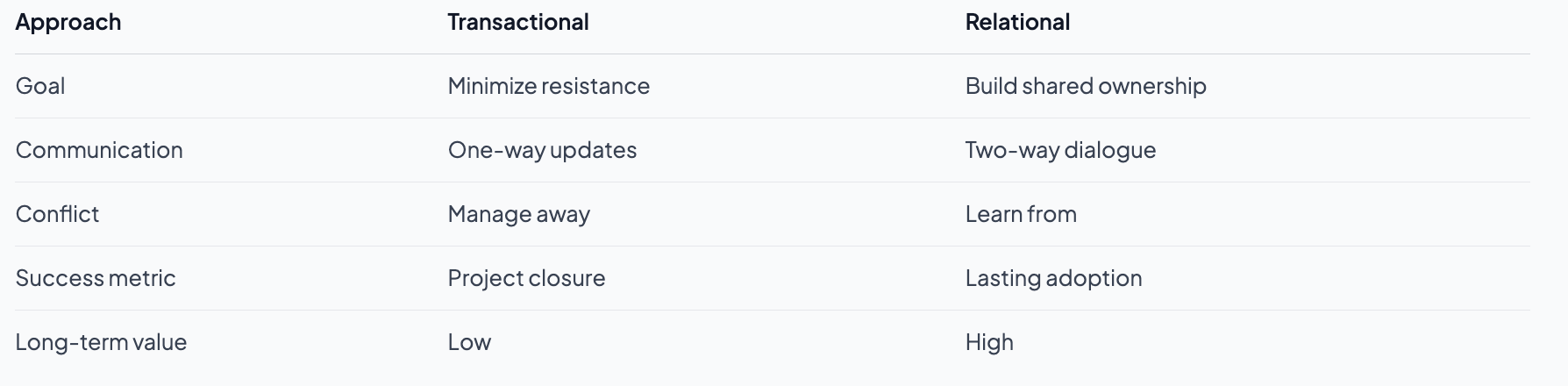
Relational stakeholder strategy consistently outperforms the transactional model in tech projects where adoption, change management, and sustained use are the real measures of success.
Win-win approaches worth building into your process:
Pro Tip: Run a “benefits storming” session early in your project. Instead of jumping straight to requirements, ask each stakeholder group what success looks like from their perspective. You’ll spot alignment opportunities you never would have found in a traditional requirements workshop.
A project portfolio approach that builds relational stakeholder thinking into every initiative creates compounding returns over time. And if you’re curious where this is heading, future stakeholder strategies in 2026 increasingly lean on AI-assisted sentiment analysis and digital engagement platforms.
A practical perspective: Why effective stakeholder management is a leadership differentiator
Here’s an uncomfortable truth most delivery frameworks won’t tell you: the majority of tech project failures we’ve seen traced back not to bad code, missed sprints, or inadequate tooling. They traced back to a sponsor who didn’t do the relationship work.
Most tech leaders are rewarded for shipping features. The incentive structure rarely celebrates someone who spent three weeks patiently bringing a resistant executive around. So stakeholder management gets deprioritized until it’s an emergency. And by then, you’re doing damage control, not relationship building.
The leaders who differentiate themselves treat stakeholder engagement as a core delivery competency, not a soft skill sidebar. They assign a dedicated leadership champion to own the stakeholder success plan, not just the project plan. They understand that project management value is multiplied when relationships are managed with the same rigor as risks and resources.
The most successful tech projects we’ve observed have one thing in common: stakeholders who felt genuinely consulted, not just informed. That’s a leadership choice, made consistently, long before go-live.
Get tailored help with stakeholder management
Most stakeholder management advice stops at "communicate early and often." DazIQ goes further. Our AI coach Daz puts you inside the high-pressure scenarios your certification never prepared you for — and works through them with you, Socratically, until the judgment becomes instinct. Tailored simulations. Real scenarios. Built for PMs, POs, Program Managers, and Scrum Masters who know the theory and need the reps. Daziq.io

At Fifty1 Consulting, we work with tech leaders and project sponsors to build stakeholder management strategies that actually stick. Whether you need advisory support on a high-stakes initiative or want to formalize your team’s engagement practices, our consulting services are designed to meet you where you are. Reach out and let’s build something that works for your organization, not just your project plan.
Frequently asked questions
What are the key criteria for segmenting stakeholders?
Segment stakeholders by their level of power, interest in the project, and current disposition, such as champion, supporter, neutral, skeptic, or opponent. These three dimensions together drive how you allocate your engagement time and resources.
How do you handle resistance from difficult stakeholders?
Start by diagnosing the real cause. Difficult resistance often comes from a fear of losing control, a gap in information, misaligned incentives, or a genuinely valid concern about the project direction. Match your response to the root cause, not the surface behavior.
What is an escalation framework in stakeholder management?
An escalation framework is a structured process with defined levels, triggers, owners, and timelines. It gives your team a clear path to resolve stalled decisions without letting conflict drag on and derail delivery.
Why is stakeholder theory important for tech projects?
Stakeholder theory pushes teams beyond transactional thinking toward a win-win mindset. Theory principles like context sensitivity, interdependence, and normative ethics help create outcomes that sustain beyond project closure and build long-term organizational trust.
Recommended:


