
Scrum Master: What the Role Actually Means
TL;DR:
- A Scrum Master is a servant-leader who coaches teams on Agile principles and facilitates their self-organization. Their role varies significantly depending on organizational context, from startups to enterprises, requiring adaptability and influence beyond ceremonies. Effectiveness is measured indirectly through team performance and continuous improvement, not by direct deliverables.
Most people in delivery leadership think they understand what a Scrum Master does. Most of them are wrong. If you’ve ever heard someone say “our Scrum Master is basically just the project manager but Agile,” you’ve already spotted the problem. The Scrum Master role is one of the most misunderstood positions in Agile project management, and that misunderstanding costs teams real delivery performance. This article cuts through the confusion and gives you a clear, practical view of what a Scrum Master actually does, why the role is distinct, and what it takes to get it right.
Key takeaways

What a Scrum Master actually does
The Scrum Master is a servant-leader who coaches the team on Scrum principles and creates an environment where self-organization can thrive. Think of it less like a boss and more like a very well-informed referee who also happens to run interference against everything trying to derail the game.
The Scrum framework includes five core events that the Scrum Master facilitates to keep the team aligned and continuously improving:
- Sprint Planning: Helps the team pull work from the backlog and define a realistic sprint goal.
- Daily Scrum: A 15-minute time-boxed touchpoint where the team coordinates. The Scrum Master keeps it focused and short, not a status meeting.
- Sprint Review: Timeboxed to about 1 hour per week of sprint, this is where the team demonstrates work and gets stakeholder feedback.
- Sprint Retrospective: Runs roughly 45 minutes per week of sprint. The Scrum Master creates psychological safety so the team can honestly assess what's working and what isn't.
- Product Backlog Refinement: Not always counted as a formal event, but a Scrum Master supports this process to keep the backlog healthy and sprint-ready.
Beyond running ceremonies, a Scrum Master’s job is removing impediments. Common blockers include bureaucratic red tape, accumulated technical debt, and stakeholder interruptions mid-sprint. The Scrum Master owns none of the deliverables. They own the process that makes delivering them possible.
Pro Tip: If your Scrum Master is spending most of their time assigning tasks or chasing status updates, that’s a warning sign. Those activities belong in a different role.
Scrum Master vs. project manager
These two roles are not interchangeable. Treating them as the same is the organizational equivalent of asking your team’s coach to also play quarterback. It sounds efficient. It isn’t.
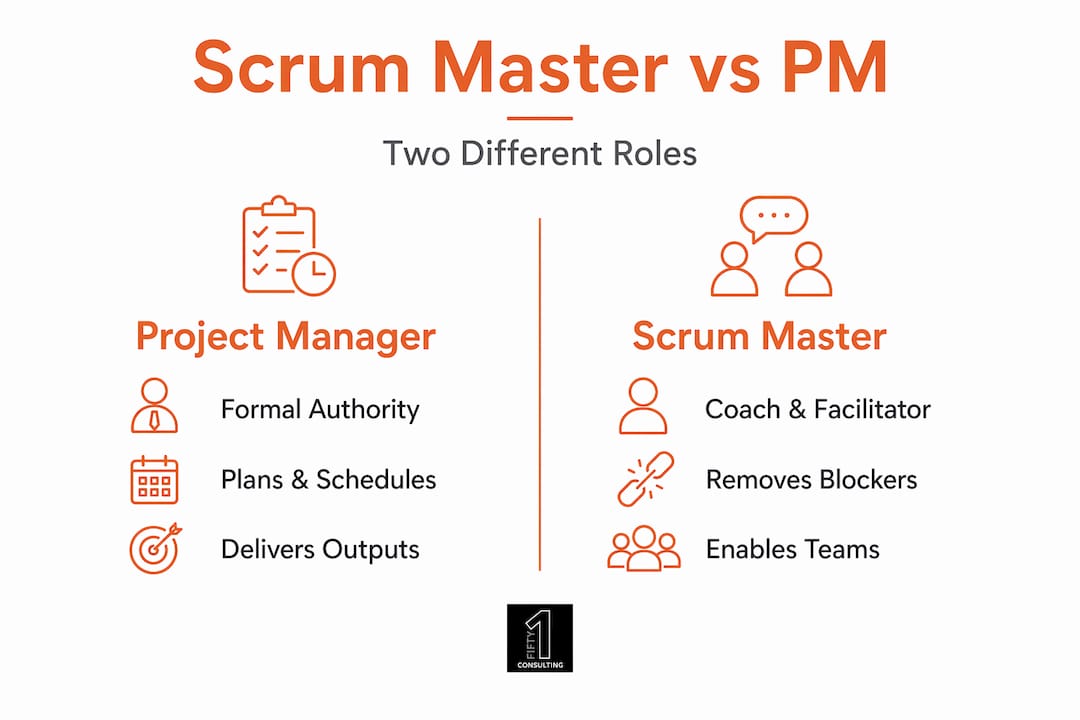
Project managers and Scrum Masters have fundamentally different orientations toward authority. A project manager owns the plan. A Scrum Master owns the conditions that allow the plan to succeed. If you force someone with a traditional PM mindset into a Scrum Master seat without retraining, they’ll drift toward control. And control is the opposite of what a self-organizing team needs.
This isn’t a knock on project managers. Understanding project management as a discipline is genuinely useful. But the Scrum Master role requires a completely different operating model. Misassigning the role is one of the most common failure patterns in Agile adoption. You don’t realize it’s happening until your sprint ceremonies feel like weekly status meetings and nobody is improving.
Pro Tip: Ask yourself: is the Scrum Master creating space for the team to solve problems, or solving the problems for them? The answer tells you whether you have a Scrum Master or an expensive project coordinator.
How context changes the job
Here’s something most Scrum Master job descriptions won’t tell you: the role looks significantly different depending on where you’re working. A Scrum Master at a 20-person startup and a Scrum Master at a Fortune 500 enterprise technically hold the same title but face wildly different realities.
Organizational context shapes the Scrum Master’s day-to-day priorities more than most people acknowledge. Here’s how that plays out:
- Startups: Scrum Masters may get pulled into technical problem solving, tool selection, or even hands-on delivery support. The team is small, the pace is fast, and formality is low. The Scrum Master has to be comfortable with ambiguity and willing to wear multiple hats without losing sight of the coaching role.
- Mid-size companies: This is where political dynamics start entering the picture. Scrum Masters spend more time managing stakeholder expectations, shielding the team from scope creep, and educating leadership about Agile communication practices.
- Large enterprises: The job becomes less about the team and more about the organization. Scrum Masters here often act as change agents working to shift institutional culture toward empirical delivery. They navigate procurement processes, compliance requirements, and multi-team dependencies that would make a startup founder's head spin.
Scrum Masters act as change agents beyond their immediate teams. That’s not a nice-to-have quality. In large organizations, it’s the job. If your Scrum Master only knows how to run ceremonies but can’t influence leadership or navigate organizational resistance, they’ll hit a ceiling fast.
The hardest part? Changing organizational culture is the single biggest challenge in the Scrum Master role. It requires patience, adaptive communication, and the ability to build trust with people who are skeptical of Agile for very legitimate reasons. No two-day certification course teaches you how to do that.

Emerging trends reshaping the role
The Scrum Master role isn’t static. AI-augmented development has introduced a new category of complexity that most teams are still figuring out.
AI-augmented development creates higher throughput but more variance in what teams can actually complete in a sprint. When a developer can generate code faster using AI tools, sprint planning assumptions built on historical velocity start breaking down. Scrum Masters have to adapt their ceremonies and coaching style to account for this new dynamic rather than pretending the old models still apply cleanly.

Measuring a Scrum Master’s effectiveness has always been tricky because the results are indirect. You don’t measure them by their own output. You measure them by the team’s output. Teams consistently delivering 85% to 95% of sprint commitments are a strong signal that someone is doing solid Scrum Master work behind the scenes. Teams that perpetually miss sprint goals or skip retrospectives are signaling the opposite. Scrum Master effectiveness requires reading those signals and adjusting the approach accordingly.
Practical tips for aspiring Scrum Masters
If you’re looking to step into the Scrum Master role or improve your current practice, here’s what actually matters.
- Get certified, but don't stop there. CSM and PSM certifications are widely used hiring filters and they require completing a two-day course plus an exam. They get you in the door. They don't make you effective. Real effectiveness comes from applying the framework under pressure with real teams.
- Don't become the Scrum police. Effective Scrum Masters coach teams to understand the why behind the framework, not just the rules. If your team follows Scrum because they understand how it helps them, you've done your job. If they follow it because you enforce it, you've created compliance, not capability.
- Protect team autonomy while staying present. Your job is to facilitate, not to make decisions for the team. There's a real temptation to jump in and solve problems. Resist it. Create the conditions for the team to solve their own problems and step in only when they genuinely can't move forward.
- Build influence before you need it. Relationships with stakeholders, product owners, and leadership matter enormously. You can't remove a significant organizational impediment if nobody trusts or respects you. Invest in those relationships early, not when you're in crisis mode.
- If you're supporting multiple teams, set boundaries. Running Scrum events for two or three teams simultaneously can dilute your effectiveness. Be honest about capacity and prioritize depth of coaching over breadth of coverage.
Pro Tip: The coaching mindset separates average Scrum Masters from exceptional ones. Ask more questions than you answer. The team’s ability to self-diagnose is more valuable than any answer you hand them.
My honest take on the Scrum Master role
I’ve watched organizations hire Scrum Masters and immediately turn them into meeting schedulers. That’s not Agile. That’s just project coordination with a fancier title.
The teams I’ve seen genuinely improve with a Scrum Master at the helm share one thing in common: leadership got out of the way and let the Scrum Master do the actual job. When there’s organizational resistance or a misaligned executive who wants weekly status decks instead of working software, even a great Scrum Master will struggle. The role requires organizational support, not just individual skill.
I’ll be blunt: the Scrum Master position is harder than it looks on paper. You’re accountable for process health but have no formal authority. You’re expected to influence cultural change but often work without organizational mandate. And your success is measured by what the team does, not what you do. If you’re naturally a control-oriented person who likes clear ownership, this role will challenge you in ways no certification prepares you for.
But when a Scrum Master operates in an environment that genuinely supports the role, the impact on team dynamics is real, measurable, and often dramatic. That’s worth the effort.
Build real Scrum Master skills before the interview
Reading about the Scrum Master role is a solid start. Actually practicing decisions under real delivery pressure is a different thing entirely.

That’s the gap DazIQ closes. DazIQ is an AI-powered career simulation platform built by the team at Fifty1consulting specifically for program, project, product, and Scrum professionals. Instead of passive reading or flashcard drills, you work through Socratic coaching scenarios that force you to make real decisions in realistic delivery situations. Budding Scrum Masters use it to build judgment before stepping into their first role. Experienced practitioners use it to pressure-test their instincts and sharpen skills that certifications don’t develop. If you want to walk into a Scrum Master interview or your first sprint with actual confidence, not just a credential, DazIQ’s closed beta is worth exploring at daziq.io.
FAQ
What does a Scrum Master do?
A Scrum Master facilitates Scrum events, removes team impediments, and coaches the team on Agile practices. They operate as a servant-leader focused on process health, not delivery management.
Is a Scrum Master the same as a project manager?
No. Project managers own the plan, schedule, and deliverables using formal authority. Scrum Masters own process health and team coaching using influence and facilitation, without formal authority over team members.
What certifications does a Scrum Master need?
The Certified ScrumMaster (CSM) and Professional Scrum Master (PSM) are the most widely recognized credentials, each requiring a short course and exam. They establish baseline knowledge but do not replace hands-on experience.
How do you measure a Scrum Master’s effectiveness?
Effectiveness is measured indirectly through team outcomes. Teams consistently delivering 85% to 95% of sprint commitments and improving through retrospectives signal effective Scrum Master coaching.
Can one Scrum Master support multiple teams?
Yes, but with limits. Supporting more than two or three teams simultaneously risks diluting coaching quality. Depth of impact per team typically matters more than coverage across many teams.
Recommended


