

Project management roles are expected to grow 7% by 2033, creating unprecedented opportunities for certified professionals. As organizations increasingly demand verified expertise in technology delivery, certifications have become essential differentiators in a competitive job market. This article explains how certifications impact your career trajectory, enhance project effectiveness, and position you for leadership roles. You’ll discover which credentials align with your goals, how they improve delivery outcomes, and practical strategies for earning and maintaining them. Whether you’re starting your project management journey or advancing to senior positions, understanding certification pathways can accelerate your professional growth.
Key takeaways
Why certifications matter in project management today
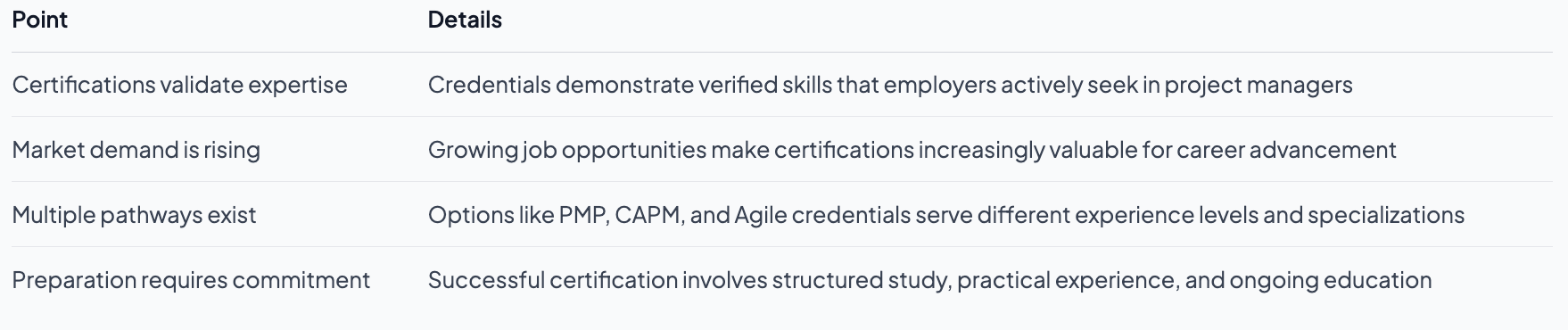
The landscape for project managers has transformed dramatically. With project management positions growing 7% by 2033, competition for these roles intensifies. Certifications provide tangible proof of your capabilities, setting you apart from candidates with equivalent experience but no credentials.
Employers increasingly require or strongly prefer certified candidates. This preference stems from certifications demonstrating standardized knowledge across methodologies, tools, and best practices. When hiring managers review applications, credentials signal you’ve invested in professional development and committed to industry standards.
Certifications also promote consistency in how organizations execute projects. Teams led by certified managers tend to follow proven frameworks rather than improvised approaches. This standardization reduces risk and improves outcomes, especially in technology delivery where complexity demands disciplined execution.
The value extends beyond initial hiring. Many organizations tie promotions and salary increases to certification achievement. You’re not just proving competence for one role but positioning yourself for advancement throughout your career. As project management trends evolve in 2026, staying certified keeps your skills aligned with industry expectations.
Most certifications require ongoing education to maintain active status. This built-in renewal process ensures you continuously update your knowledge as methodologies, technologies, and business environments change. You’re never working with outdated information, which matters tremendously in fast-moving tech sectors.
Pro Tip: Research which certifications your target employers value most by reviewing job postings in your desired field and speaking with hiring managers.
Common project management certifications and their benefits
Navigating certification options can feel overwhelming. Understanding the major credentials helps you select the path aligned with your experience level and career objectives.
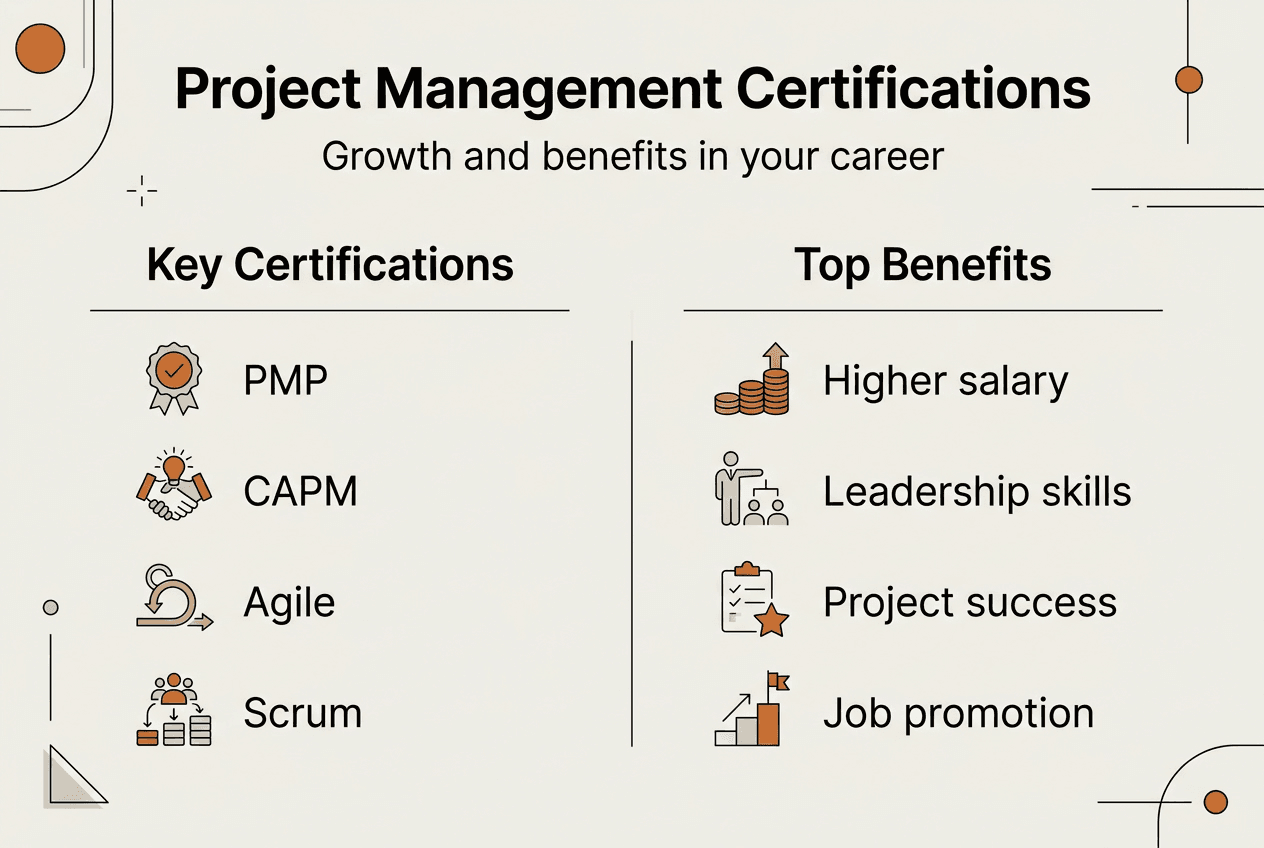
The Project Management Professional (PMP) stands as the gold standard. Offered by the Project Management Institute, PMP requires substantial experience and demonstrates mastery across all project phases. Organizations worldwide recognize this credential, making it valuable regardless of industry or geography. The benefits of PMP certification extend to both career advancement and practical project execution capabilities.

For those starting their project management careers, the Certified Associate in Project Management (CAPM) provides an entry point. CAPM requires less experience than PMP but covers foundational concepts thoroughly. This certification suits professionals transitioning into project management or recent graduates seeking to establish credibility quickly.
Agile and Scrum certifications focus on iterative, flexible delivery approaches increasingly common in technology projects. Credentials like Certified ScrumMaster (CSM) or PMI Agile Certified Practitioner (PMI-ACP) emphasize adaptive planning, continuous improvement, and collaborative team structures. Tech companies particularly value these certifications as software development increasingly follows Agile principles.
Certain certifications align better with specific domains. For technology delivery, combining traditional project management credentials with Agile certifications creates a powerful skill set. You demonstrate versatility in applying both predictive and adaptive methodologies depending on project needs.
Choosing the right certification depends on three factors: your current experience level, career goals, and the domains where you work or want to work. Entry-level professionals should consider CAPM before pursuing PMP. Those in tech-focused roles benefit from Agile credentials. Senior practitioners might pursue multiple certifications to demonstrate comprehensive expertise.

Pro Tip: Consider stacking certifications over time rather than pursuing everything simultaneously, building from foundational to advanced credentials as your career progresses.
Before committing to PMP exam preparation, evaluate which certification delivers the most immediate value for your current role and next career move.
How certifications enhance project delivery and leadership skills
Certifications don’t just look impressive on resumes. They fundamentally improve how you manage projects and lead teams. The competencies developed through certification programs directly translate to better project outcomes.
Certified managers consistently achieve higher project success rates. This improvement stems from applying proven methodologies rather than trial and error. You learn frameworks for initiating, planning, executing, monitoring, and closing projects that have worked across thousands of organizations. When challenges arise, you draw on established best practices instead of improvising solutions.
Certification coursework strengthens critical soft skills alongside technical knowledge. You develop better communication strategies for different stakeholder groups. Risk management becomes systematic rather than reactive. Stakeholder engagement improves as you learn techniques for identifying interests, managing expectations, and building consensus.
Leadership capabilities grow substantially through certification preparation. You study team dynamics, conflict resolution, and motivation strategies that create high-performing groups. These skills prove essential in technology delivery where cross-functional teams must collaborate effectively despite different priorities and working styles.
The confidence boost from certification shouldn’t be underestimated. When you’ve demonstrated mastery through rigorous examination, you approach complex projects with greater assurance. This confidence translates to better decision-making under pressure and more effective advocacy for your team’s needs.
As noted in discussions of how certifications improve competencies for project managers, the structured learning process helps you internalize principles that become second nature. You stop consciously thinking about which tool to apply and instead instinctively select appropriate approaches for each situation.
Pro Tip: Apply certification concepts to real projects during your study period, reinforcing theoretical knowledge through practical experience.
The connection between certification and project success becomes evident when examining the role of leadership in project success, where credentialed managers demonstrate measurably better outcomes.
Preparing for and maintaining project management certifications
Earning certifications requires strategic preparation. Success depends on combining structured study with practical application and understanding the ongoing commitment involved.
Effective study plans balance time management with comprehensive coverage. Most candidates underestimate preparation time needed for rigorous exams like PMP. Allocate at least three months for focused study, breaking material into manageable sections. Use official study guides and practice exams to familiarize yourself with question formats and identify knowledge gaps.
Practical project experience complements theoretical knowledge powerfully. The best preparation involves actively managing projects while studying. You’ll recognize concepts in action, making abstract principles concrete. This real-world application also helps you answer situational questions that test judgment rather than memorization.
Most certifications require ongoing professional development units (PDUs) or continuing education units (CEUs) to maintain active status. PMP holders must earn 60 PDUs every three years through activities like attending conferences, completing courses, or volunteering. This requirement ensures your knowledge stays current as methodologies evolve.
Renewal processes vary by certification. Some require retesting after a set period, while others accept continuing education alone. Understanding these requirements before pursuing certification helps you assess the long-term commitment involved. Factor renewal costs and time into your decision-making process.
Joining study groups significantly improves preparation effectiveness and motivation. Collaborating with peers provides accountability, different perspectives on challenging concepts, and emotional support during intensive study periods. Online communities and local PMI chapters offer numerous opportunities for group study.
Pro Tip: Schedule your exam date before completing all preparation to create urgency and prevent indefinite postponement.
Resources like PMP exam preparation guides and the PMP Exam Playbook provide structured approaches that streamline your study process and increase first-attempt pass rates.
Ready to Accelerate Your Delivery Career? Meet DazIQ.
Navigating the skills, scenarios, and judgment calls that define great program, project, product, and Scrum professionals doesn't have to feel like guesswork. Whether you're pursuing a new credential, leveling up your delivery skills, or preparing to step into a more senior role — the gap between knowing the theory and demonstrating it under pressure is where most professionals get stuck.
DazIQ changes that.
Built by Fifty1 Consulting, DazIQ is an AI-powered career simulation platform that puts you inside real delivery scenarios — and coaches you through them. No passive reading. No rote flashcards. Just Socratic, hands-on simulations that develop the judgment and decision-making skills that actually matter in the room.
We're launching our Beta and spots are limited.Be among the first delivery professionals to train the way the best already think.
👉 Sign up for the DazIQ Beta at daziq.io

FAQ
What is the fastest certification to obtain in project management?
The Certified Associate in Project Management (CAPM) typically represents the quickest path to certification. CAPM requires minimal experience compared to advanced credentials, allowing entry-level professionals to qualify relatively quickly. Preparation time varies based on your existing knowledge and study commitment, but many candidates complete the process in two to three months. Focus on understanding foundational concepts rather than rushing through material, as thorough preparation ensures first-attempt success.
Do project management certifications expire?
Most major certifications require renewal every three years through continuing education or retesting. PMP holders must earn 60 professional development units during each three-year cycle to maintain active status. Failure to complete renewal requirements results in certification lapse, requiring you to retake the full exam. Some organizations offer suspended status allowing late renewal with penalties, but policies vary by certifying body. Track your renewal deadline from the day you earn certification to avoid unintentional expiration.
Can certifications help with salary growth?
Certified project managers typically earn higher salaries compared to non-certified peers with similar experience. Credentials validate skills that employers value, justifying premium compensation. The salary advantage varies by industry, location, and specific certification, but PMP holders often command 15-25% higher pay than non-certified managers. Beyond initial salary, certifications position you for promotions and leadership roles with greater earning potential. Consider certification an investment that pays dividends throughout your career.
How do I choose between PMP and Agile certifications?
Your choice depends on your work environment and career direction. PMP suits professionals managing traditional projects with defined scopes, schedules, and budgets. Agile certifications like CSM or PMI-ACP align better with iterative technology delivery using adaptive approaches. Many successful project managers pursue both, starting with the credential most relevant to their current role. If you work in technology delivery with frequent changes and evolving requirements, begin with Agile certifications. For roles in construction, manufacturing, or other predictive environments, PMP provides greater immediate value.
Recommended


