

TL;DR:
Only half of all projects fully succeed. That’s not a typo. Empirical benchmarks confirm that 13% fail outright and another 37% only partially deliver. And yet, most organizations keep doubling down on tools, templates, and processes while ignoring the actual lever that moves the needle: leadership. If you’re a project sponsor or organizational leader in a technology environment, this article is your practical guide to understanding which leadership approaches actually change delivery outcomes, and how to put them to work immediately.
Key Takeaways
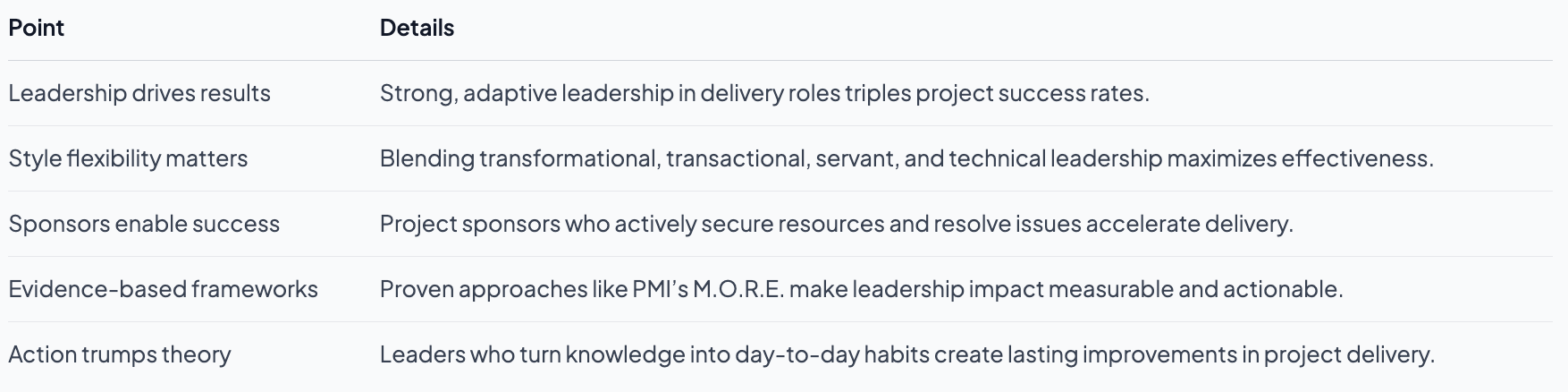
Understanding the leadership role in project delivery
Let’s clear something up right away. Leadership and project management are not the same thing. Your project manager handles schedules, tracks risks, and coordinates tasks. That’s critical work. But leadership is what determines whether your team actually wants to deliver, whether your stakeholders stay aligned, and whether the project survives the inevitable political storms inside your organization.
Leadership in project success is about setting a compelling vision, making tough calls under pressure, and keeping everyone pointed in the same direction when priorities shift. In technology environments, that’s harder than it sounds. Teams are cross-functional, timelines are compressed, and stakeholder expectations change fast.
Here’s what strong leadership actually looks like in a technology project:
Leadership styles like transformational, transactional, servant, and technical are especially critical in agile environments, where they directly enhance team performance, innovation, and adaptability. Agile isn’t just a methodology. It’s a leadership challenge.
“The biggest risk in technology delivery isn’t a technical one. It’s the absence of leaders who can hold the vision steady while everything else is changing.”
Project sponsors, in particular, carry a unique leadership burden. They’re not in the daily standups. But they’re the ones who can unlock budget, break political gridlock, and reframe priorities at the executive level. Without active sponsor leadership, even the best project managers are fighting with one hand tied behind their back. Understanding project management fundamentals is the starting point, but leadership is what elevates delivery from average to exceptional.
Comparing leadership styles and their impact
Now that you understand what leadership does, let’s talk about the different flavors. Not all leadership styles work equally well in every situation, and the best tech leaders know when to shift gears.
Leadership styles in agile projects fall into four main categories, each with distinct strengths:
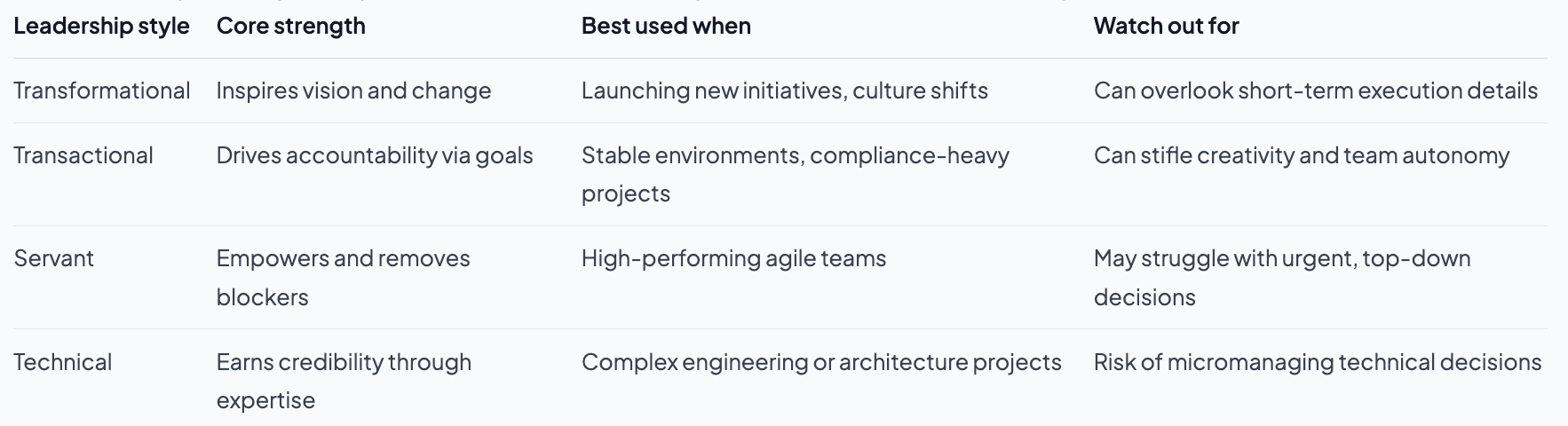
Each style has a legitimate role. The mistake most leaders make is defaulting to one style regardless of context. Think of it like a golf bag: you don’t use a driver for every shot. Transformational, transactional, servant, and technical leadership each serve a purpose, and the most effective leaders blend them based on team maturity, project phase, and organizational culture.
Here’s a practical way to identify your default style:
Once you know your default, you can intentionally stretch into other styles. A technical leader who learns to inspire with vision becomes exponentially more effective. A transformational leader who tightens up on accountability stops letting great ideas die in execution. The synergy between styles is where real delivery magic happens.
Here’s a truth most delivery conversations skip over: the sponsor is often the most important person on the project, and also the most underutilized. When sponsors are passive, projects drift. When sponsors are active and strategic, projects move.
Project sponsors provide strategic direction, resolve conflicts, secure resources, and maintain alignment with business objectives. They act as friction breakers and political architects. That last phrase is worth sitting with. Political architect. Your job as a sponsor isn’t just to approve the budget and show up at steering committee meetings. It’s to actively shape the environment in which your project can succeed.
Here’s what proactive sponsorship looks like in practice:
Consider a real scenario: a technology modernization project stalls because two business units can’t agree on data ownership requirements. The project manager escalates. Nothing happens. The sponsor steps in, facilitates a conversation at the VP level, and gets a decision in 48 hours. That’s not project management. That’s sponsorship.
“A great sponsor doesn’t just remove blockers. They prevent them from forming in the first place.”
Pro Tip: Schedule a monthly 30-minute “sponsor check-in” focused entirely on organizational risks, not project status. Your PM has the status covered. Your job is to scan the political horizon and clear the path.
Understanding the impact of PMO in tech projects can also help sponsors recognize where formal governance structures amplify their strategic influence across a portfolio of initiatives.
Linking leadership decisions to delivery outcomes: The evidence
Let’s talk numbers, because the data here is genuinely striking.
Only 50% of projects succeed fully, with 13% failing outright and 37% delivering only partial results. But here’s where it gets interesting: apply strong leadership through PMI’s M.O.R.E. framework, and success rates climb to 94%. That’s not a marginal improvement. That’s a transformation.


So what is PMI’s M.O.R.E. approach? It stands for Mindset, Objectives, Resources, and Execution. Here’s the breakdown:
The data on high business acumen leaders is equally compelling. When project leaders deeply understand the business context, goal achievement jumps to 83%, schedule performance reaches 63%, and budget performance hits 73%, while failure rates drop to just 8%.
📊 Statistic worth bookmarking: Strong leadership via M.O.R.E. triples project success rates compared to the industry baseline.

Pro Tip: Use M.O.R.E. as a quarterly leadership audit. Ask yourself and your team: Are we aligned on Mindset? Are our Objectives still sharp? Do we have the Resources we need? Is our Execution disciplined? Four questions. Enormous impact.
For leaders managing large-scale initiatives, delivering big initiatives without a PMO offers practical guidance on maintaining leadership rigor without heavy bureaucracy. And if you want to understand the financial case, project management resource savings lays out the numbers clearly. For a forward-looking view, project management trends 2026 is worth your time.
Turning insight into action: Practical leadership strategies
Data and frameworks are only useful if you actually change your behavior. So let’s get concrete.
The single biggest shift most tech leaders need to make is from reactive to proactive. Reactive leaders show up when things break. Proactive leaders create conditions where things are less likely to break in the first place. That’s a mindset shift, and it starts with your daily habits.
Here’s what top-performing delivery leaders do consistently:
Transformational and servant leadership are especially effective in agile environments because they create psychological safety, which is the foundation of high-performing teams. When people feel safe to raise problems early, you catch issues before they become disasters.
Common pitfalls to avoid:
Agile delivery for business teams is a great resource if you’re working to bring these leadership practices into non-engineering contexts. And if you’re thinking about where leadership in this field is heading, the future of project leadership is worth reading.
Why leadership is the missed lever in technology project delivery
Here’s our honest take: most delivery failures we see aren’t caused by bad tools, wrong methodologies, or even poor planning. They’re caused by leadership gaps that nobody wants to name out loud.
Organizations invest heavily in software licenses, certifications, and process frameworks. Those things matter. But they’re not what makes a team trust each other enough to raise a red flag before it becomes a crisis. They’re not what makes a sponsor fight for a project when the budget committee comes calling. They’re not what makes an engineer stay late because they actually believe in what they’re building.
Leadership’s real impact shows up in team dynamics, trust, and the willingness to have hard conversations early. The leaders who understand this stop asking “what process should we follow?” and start asking “what does my team need from me right now?”
That shift, from process-first to people-first leadership, is what separates organizations that consistently deliver from those that consistently explain why they didn’t. Invest in leadership capacity, yours and your organization’s. It’s the highest-return investment in your delivery portfolio.
DazIQ changes that.
Built by Fifty1 Consulting, DazIQ is an AI-powered career simulation platform that puts you inside real delivery scenarios — and coaches you through them. No passive reading. No rote flashcards. Just Socratic, hands-on simulations that develop the judgment and decision-making skills that actually matter in the room.
We're launching our Beta and spots are limited.Be among the first delivery professionals to train the way the best already think.
👉 Sign up for the DazIQ Beta at daziq.io

Frequently asked questions
What leadership style works best for technology project delivery?
No single style works best. Transformational, transactional, servant, and technical leadership all play a role in technology delivery, and the most effective leaders adapt their style based on team needs and project context.
How can sponsors most impact project delivery?
Sponsors drive alignment, secure resources, and resolve conflicts at levels the project manager can’t reach. Strategic direction and conflict resolution from sponsors are what keep projects on track when organizational friction hits.
Does strong leadership really improve delivery results?
Absolutely. Strong leadership via PMI’s M.O.R.E. approach triples project success rates from the 50% baseline to 94%, making leadership the single most impactful variable in delivery outcomes.
What are common pitfalls for leaders in delivery?
Micromanaging technical work, sticking rigidly to one leadership style, and neglecting stakeholder alignment are the three most common mistakes that derail otherwise well-planned technology projects.
How can leaders develop better delivery skills?
Continuous learning, structured feedback, and applying proven frameworks like PMI’s M.O.R.E. approach accelerate leadership growth faster than any single certification or training program alone.
Recommended


