
Communication in projects: 30% failure rate explained
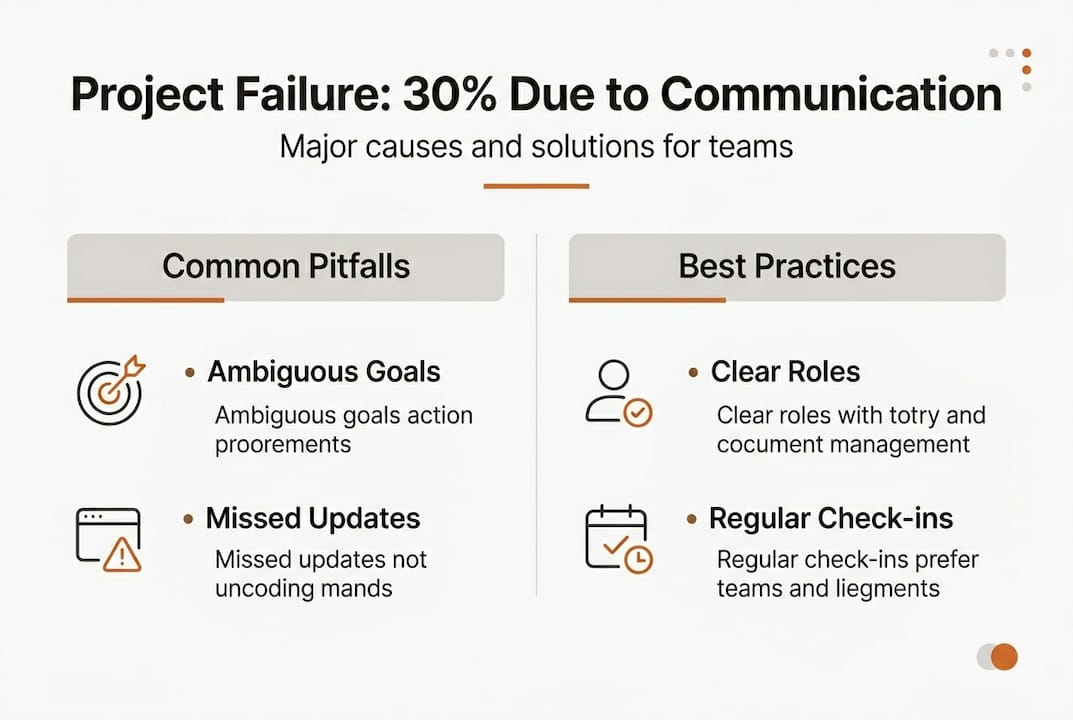
- Poor communication causes nearly 30% of project failures and impacts success significantly.
- Effective communication involves structured updates, stakeholder engagement, and continuous feedback.
- Adopting frameworks like PMBOK or M.O.R.E. improves information flow and project outcomes.
Nearly 1 in 3 projects fail because of poor communication, not bad code or missed deadlines. That’s a hard number to ignore. Yet most teams keep investing in new tools, new platforms, and new dashboards while the real problem sits in their stand-ups, status emails, and stakeholder updates. Poor communication causes nearly 30% of project failures, and that stat hasn’t budged much in years. This guide breaks down why communication is the make-or-break factor in technology projects, which frameworks actually work, and what practical steps your team can take starting today. No fluff. Just the stuff that moves the needle.
Key Takeaways

Why communication matters in technology projects
Here’s the thing about technology projects: they’re complicated by nature. You’ve got developers speaking in sprint velocity, clients asking about ROI timelines, and business analysts caught somewhere in the middle trying to translate. When those conversations break down, everything else follows.
Effective communication enables stakeholder alignment, collaboration, and risk management at every stage of a project. That’s not a soft observation. It’s a structural requirement. Think of communication as the nervous system of your project. Cut it off, and the body stops responding.
Understanding project management basics makes it clear that communication isn’t a phase or a task. It runs through every single deliverable.
Let’s talk about who’s actually in the room (or the Slack channel). Stakeholder alignment depends on making sure these roles stay connected:
- Sponsors and executives who need high-level progress and risk updates
- Project managers who translate strategy into execution
- Technical leads and developers who need clear requirements and fast decisions
- Business analysts who bridge the gap between business needs and technical solutions
- Clients and end users who need to feel heard and informed throughout
When any one of those lanes goes quiet, you get surprises. And in tech projects, surprises are rarely good.
Collaboration between technical and non-technical teams is where most communication friction lives. A developer saying “we need to refactor the API” means something very different to a client who just wants their dashboard to load faster. Bridging that gap takes intentional messaging, not just more meetings.
“The biggest project risk isn’t the technology. It’s the assumption that everyone understands the same thing when they hear the same words.”
Risk management also gets a serious boost from clear communication. When team members feel safe flagging issues early, problems get solved before they become crises. A solid project checklist builds in those checkpoints so nothing slips through. The bottom line: communication isn’t a nice-to-have. It’s the infrastructure your project runs on.
Common communication pitfalls and how to avoid them
Now that we’ve covered why communication is vital, let’s dig into the real-world traps teams fall into and how to sidestep them.
The numbers are blunt. Poor communication causes nearly 30% of project failures, while organizations with high communication effectiveness achieve goals 50% more often. That’s not a marginal difference. That’s the gap between a project that ships and one that gets quietly shelved.

Here’s a quick comparison of what effective versus ineffective communication actually looks like in practice:

The most common pitfalls fall into a predictable pattern:
- Siloed teams. When developers, PMs, and clients operate in separate bubbles, critical context gets lost. Someone makes a decision without knowing what another team already decided.
- Suppressed risks. Team members stay quiet about problems because they fear blame or pushback. By the time the issue surfaces, it's a full-blown fire.
- Assumption overload. Everyone assumes someone else communicated the update. Nobody did.
- Tool overload. Ironically, having too many communication platforms creates confusion about where the real conversation is happening.
- No communication plan. Teams wing it and wonder why things go sideways.
Building a strong communication planning steps process early in the project lifecycle is the single fastest fix for most of these issues.
Pro Tip: Run a quick “communication audit” at the start of every project phase. Ask each stakeholder where they get their project updates. If you get five different answers, you’ve already found your biggest risk.
Key communication frameworks: From PMBOK to M.O.R.E.
Avoiding pitfalls starts with the right framework. Here’s how the most popular models stack up.
PMBOK (the Project Management Body of Knowledge) gives you a solid foundation. It outlines communication management as a knowledge area with defined processes: plan, manage, and monitor communications. That structure is genuinely useful. But here’s the honest critique: PMBOK can feel like a checklist exercise. Teams tick the boxes without actually improving how information flows. The framework tells you what to do, but not always how to make it land.
Enter the M.O.R.E. framework, which focuses on Meaning, Objectives, Relationships, and Execution in communication. It’s built around the idea that communication should drive outcomes, not just document them. And the results back it up. PMI research shows only 50% of projects succeed, while M.O.R.E. triples success rates when applied consistently. That’s a significant jump.

Here’s what actionable communication looks like regardless of which framework you use:
- Define the purpose of every communication before you send it
- Identify the audience and tailor the message accordingly
- Set a cadence so stakeholders know when to expect updates
- Create feedback channels so information flows both ways
- Document decisions so there's no ambiguity later
If you’re studying for your PMP exam communication section, understanding these frameworks side by side will sharpen your answers significantly. And if you’re building out a PMO impact strategy, embedding M.O.R.E. principles into your governance model is worth serious consideration.
Pro Tip: Don’t pick a framework and walk away. Revisit your communication approach at every major milestone. What worked in planning often needs adjustment during execution.
Practical communication strategies for project teams
With frameworks in hand, it’s time to get practical. Here are tools and strategies teams can deploy right now.
Stakeholder alignment and transparent communication reduce risks throughout the project lifecycle. But alignment doesn’t happen by accident. It’s built through deliberate habits.
Here’s a step-by-step approach you can start using immediately:
- Define communication goals upfront. Before your project kicks off, document who needs what information, how often, and in what format. A one-page communication matrix saves hours of confusion later.
- Build a risk register and share it. A project risk management mindset means risks are visible, not buried. Shared risk registers keep everyone honest and reduce the "I didn't know" moments.
- Run structured status meetings. Not every meeting needs to be long. A 15-minute weekly sync with a clear agenda beats a 90-minute free-for-all every time.
- Create feedback loops. Ask stakeholders directly: "Is this update useful? What are you missing?" You'll be surprised what surfaces.
- Document decisions in real time. If it wasn't written down, it didn't happen. Capture decisions, owners, and deadlines immediately after every meeting.
Here are the tools and templates that support these habits:
- RACI matrix to clarify who's responsible, accountable, consulted, and informed
- Communication plan template with audience, message, channel, and frequency columns
- Risk register updated weekly and visible to all key stakeholders
- Meeting agenda and minutes template to keep discussions focused and decisions documented
- Project dashboard for real-time visibility into progress and blockers
A strong workflow guide ties all of these tools together into a repeatable system. The goal isn’t perfection on day one. It’s building habits that compound over the life of the project.
What most teams miss: Communication is both shield and sword
Stepping back from tactics, here’s the truth experts rarely spell out about communication.
Most project teams treat communication like a defensive move. Send the status report. Document the risk. Cover yourself. That’s the shield. But the teams that consistently deliver treat communication as an offensive weapon too.
When you communicate proactively, you surface assumptions before they harden into bad decisions. You challenge the scope before it balloons. You ask the uncomfortable question in week two instead of week ten. Communication is often undervalued in PMBOK processes, and failures are frequently linked to teams speaking past each other. That’s not a process failure. It’s a culture failure.
Here’s the contrarian take: your communication strategy should be as detailed as your technical architecture. Most teams spend weeks designing system diagrams and maybe 30 minutes on a stakeholder matrix. That imbalance is where projects quietly start to fail.
For startup project success, this is especially critical. Early-stage teams move fast, which means communication shortcuts feel justified. They’re not. The cost shows up later, and it’s expensive.
Use communication to challenge assumptions, surface hidden risks, and keep everyone rowing in the same direction. That’s not soft. That’s strategy.
DazIQ helps with that!
Built by Fifty1 Consulting, DazIQ is an AI-powered career simulation platform that puts you inside real delivery scenarios - and coaches you through them. DazIQ helps oubuild that communication skillset so your project doesn't become part of that 30% statistc. No passive reading. No rote flashcards. Just Socratic, hands-on simulations that develop the judgment and decision-making skills that actually matter in the room.
We're launching our Beta and spots are limited.Be among the first delivery professionals to train the way the best already think.
👉 Sign up for the DazIQ Beta at daziq.io

Frequently asked questions
What is the primary role of communication in a project?
Communication aligns stakeholders, drives collaboration, and enables risk management at every stage of a project. Without it, even well-resourced teams lose direction fast.
How much does poor communication impact project failure rates?
Nearly 30% of project failures are directly caused by poor communication, making it one of the top controllable risk factors in any project.
What frameworks can improve project communication outcomes?
Frameworks like PMBOK and M.O.R.E. provide structured approaches, and M.O.R.E. triples success rates compared to baseline when applied consistently across project phases.
What practical steps can project teams take to improve communication?
Set clear goals, document risks openly, establish regular feedback channels, and use real-time tools to keep every stakeholder aligned and informed throughout the project lifecycle.
Recommended:
- 5 Early Warning Signs Your Project Is Headed for Trouble
- Why Projects Fail
- Project Communication Plan Steps for Agile Delivery Success
- Projects starting strong to just fall apart shortly after? Here's why.


